Christina Chalimova, LLB, CFP®; Senior Wealth Consultant, Client Consultation Group
Estate planning is a deeply personal experience that can often feel complex, especially when it comes to understanding the nuances of the probate process and the fees that often come with it. For many Canadians, probate fees raise concerns about the potential erosion of the estate intended for their loved ones. In response, an increasing number of Canadians are turning to probate planning strategies in hopes of minimizing probate fees and facilitating the transfer of assets to their loved ones without court intervention. This article provides key insights to help you understand what probate is, what it costs, common probate planning strategies and what to consider before implementing them in your estate plan. Contact an Edward Jones Financial Advisor if you have questions.
What is probate?
Probate1 is the court process of validating your last Will after your death and confirming the executor's legal authority to administer your estate2. Applying for probate namely requires the Will to be filed with the court record for validation, which then usually renders it accessible to the public. When an application for probate is complete and the Will is not challenged, a grant of probate3 is issued by the court and your executor can begin carrying out the terms of your Will. A third party which acts in good faith on the instructions of an executor named by the court in a grant of probate is protected from liability for following those directions. As a result, financial institutions and others regularly require this document to ensure that they are dealing with the court-validated last Will and taking instructions from the person that has the lawful authority to administer the estate. Without a grant of probate, an executor or financial institution may face legal complications if they distribute assets and, later, another Will surfaces with different distribution terms, or someone challenges the Will.
How long does probate take?
Multiple factors impact the time it takes obtain a grant of probate. First, an application for probate must be completed and submitted to the court. This often requires the applicant (usually the executor named in what is believed to be the last Will of the deceased) some time to collect information on the deceased's assets/liabilities and gather key supporting documents, such as the Will and death certificate. Then, the court must process the application for probate, which may depend on how complete the application is, whether anyone challenges the Will, and the court's availability. For these reasons, and others, probate can be a complex and time-consuming process, which explains why many executors turn to a lawyer for assistance.
What are probate fees in Canada?
Applying for probate may require the payment of estate administration taxes or probate fees4. While probate fees differ across jurisdictions, they are generally levied on the gross value of the estate or more precisely, the fair market value of the assets owned by the deceased at death minus certain secured liabilities registered against real property5.
Probate fees should not be confused with income taxes payable at death as they serve distinct purposes. For instance, in addition to probate fees, capital gains taxes may need to be paid out of the estate in relation to certain assets that have increased in value during the deceased's lifetime. It should also be noted that probate fees cannot be deducted by the estate for income tax purposes.
In some jurisdictions, probate fees may be a flat fee or non-existent, while in others, they may be a percentage that can considerably reduce the value of an estate to be distributed to beneficiaries. To give you an idea of how much probate can cost, here is an illustration of probate fees due on a $1 Million estate across a few different provinces:
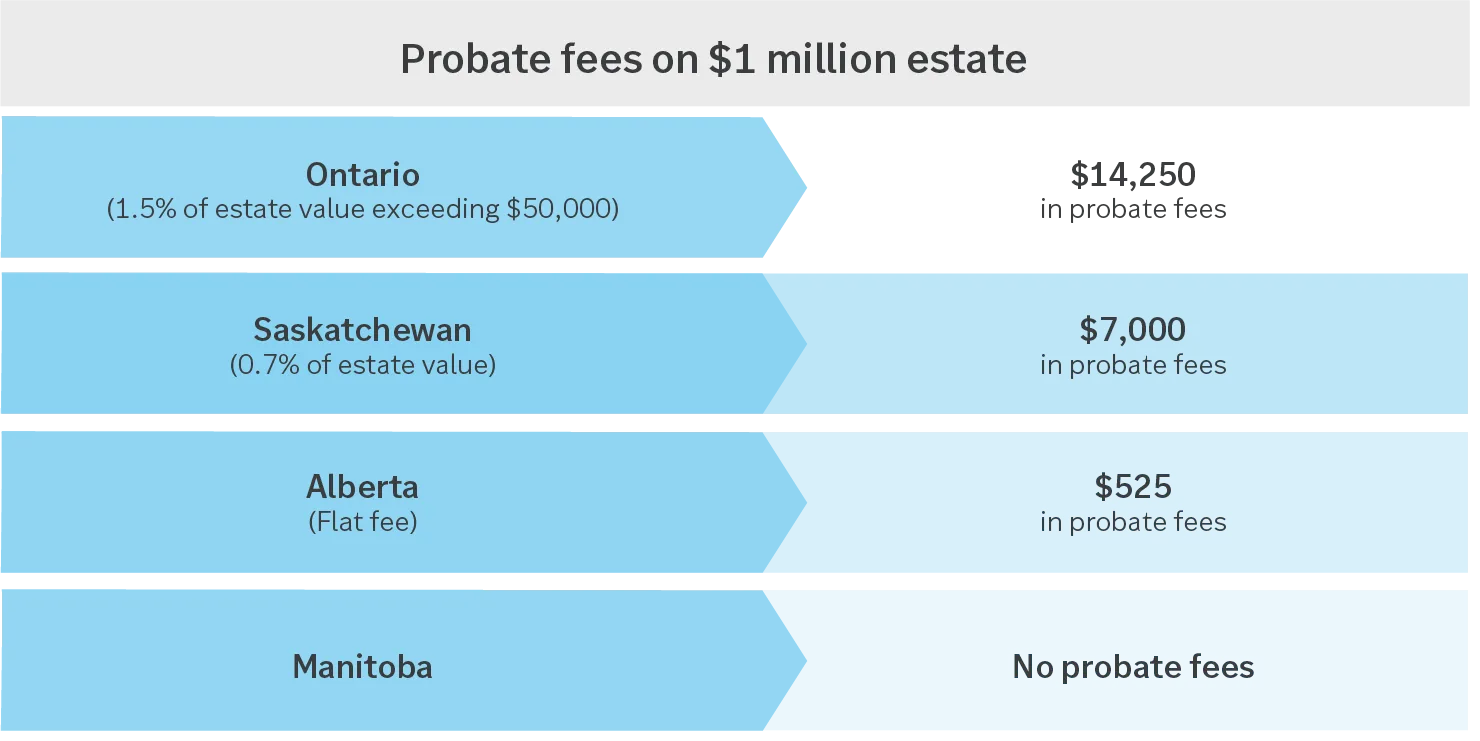
This chart shows the probate fees on a $1 million estate for Ontario ($14,250, or 1.5% of estate value exceeding $50,000), Saskatchewan ($7,000 or 0.7%), Alberta ($525 flat fee), and Manitoba (no fees)
This chart shows the probate fees on a $1 million estate for Ontario ($14,250, or 1.5% of estate value exceeding $50,000), Saskatchewan ($7,000 or 0.7%), Alberta ($525 flat fee), and Manitoba (no fees)
Before delving into the ins and outs of some probate planning strategies commonly used to reduce probate fees, here's a look at Canada's probate fees from coast-to-coast-to-coast.
Probate fees across Canada6
How can I avoid probate fees?
It is crucial to recognize that probate fee avoidance should not be the main goal of your estate plan nor does well-thought-out probate planning mean avoidance of probate on all your assets. You should always first establish your estate goals and distribution wishes, and only then evaluate whether any probate strategies can add measurable value to your estate plan through a careful cost-benefit analysis.
Probate fee avoidance should not be the main-goal of your estate plan.
While probate planning strategies have gained significant traction among Canadians residing in higher probate fee jurisdictions, it is essential to first understand which of your assets are - and are not – subject to probate.
Assets subject to probate
Generally, assets passing through your estate are subject to the probate and the associated fees. These typically include assets that will be distributed according to the instructions outlined in your Will, such as:
- Individually owned real estate that is not held in joint tenancy with rights of survivorship.
- Individually owned bank or non-registered investment account that is not held in joint tenancy with rights of survivorship.
- Registered accounts without beneficiary designations or with your "estate" named as the beneficiary;
- Insurance policies without beneficiary designations or with your "estate" named as the beneficiary;
- Private company shares held personally;
- Personal property, such as vehicles, artwork, and more.
Assets not subject to probate
Generally, assets passing outside of your estate and Will are not subject to probate. This is why, probate planning strategies aim to transfer assets outside of your estate to minimize the estate value subject to probate. Some common probate strategies used to reduce probate fees in Canada include:
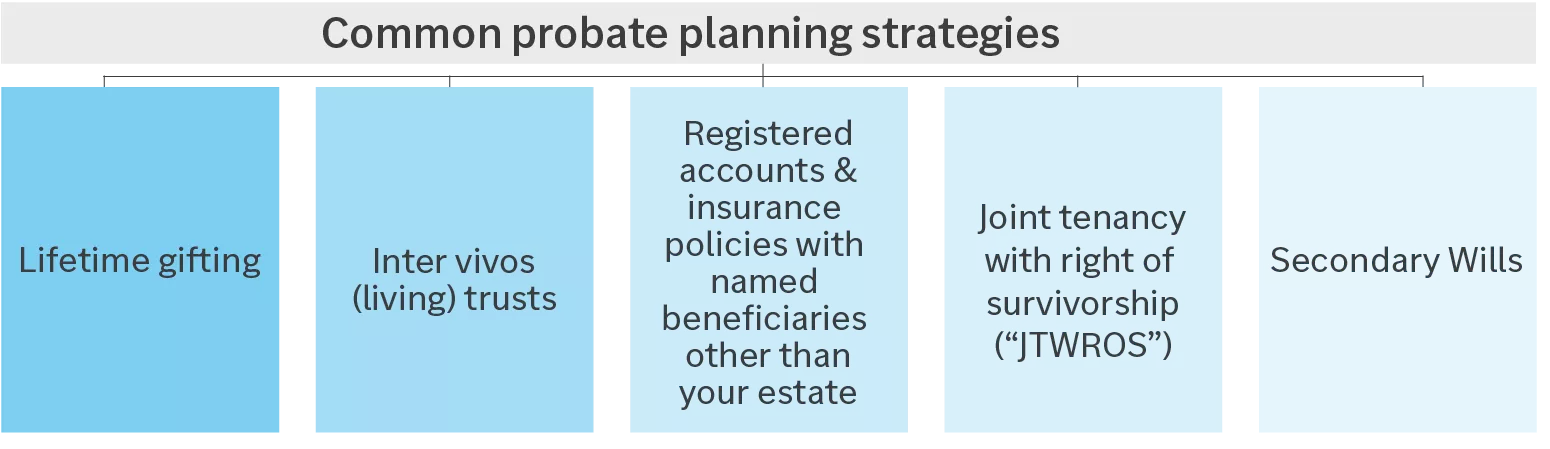
This flowchart shows that outright distributions and testamentary trusts from your will are subject to probate before distribution to your beneficiaries, while lifetime gifting, living trusts, registered accounts & insurance policies with named beneficiaries, JTWROS, and secondary wills are not.
This flowchart shows that outright distributions and testamentary trusts from your will are subject to probate before distribution to your beneficiaries, while lifetime gifting, living trusts, registered accounts & insurance policies with named beneficiaries, JTWROS, and secondary wills are not.
- Lifetime Gifting – Gifts made during your lifetime no longer belong to you and cannot form part of your estate subject to probate.
- Joint Ownership of Assets7 – Joint Tenancy with Right of Survivorship (JTWROS) is a form of asset ownership, which allows two or more individuals to collectively own an asset like real estate or a non-registered investment account. Transferring your assets into JTWROS may allow the asset to pass directly onto the surviving joint tenant(s) upon your death without forming part of your estate subject to probate.
- Beneficiary Designations8 – Naming beneficiaries other than your estate on registered accounts (e.g., RRSPs, RRIFs and TFSAs) and life insurance policies may allow those assets to pass outside of your estate directly to your designated beneficiary without requiring probate.
- Inter Vivos (Living) Trusts – Transferring your assets into an inter vivos (living) trust during your lifetime may reduce probate fees because you no longer hold legal ownership of the assets placed in the trust at death. The assets in the trust will ultimately be distributed according to the terms in the trust deed instead of your Will, which bypasses probate. Examples of inter vivos trusts include family trusts, alter ego trusts and joint partner trusts.
- Multiple Wills9 – Although not recognized as valid in all Canadian jurisdictions, the multiple Wills strategy provides for the execution of a Primary Will to deal with assets that require probate, such as individually owned accounts and real estate, and a Secondary Will to deal with certain eligible assets that do not require probate, such as certain personal items or shares in a privately held corporation. Upon your death and where applicable, only the Primary Will would be subject to probate, which would result in probate fee savings on assets governed by the Secondary Will.
Probate planning considerations
While saving on probate fees might seem like a relatively simple endeavor, the reality is that every probate planning strategy comes with its benefits and risks, which need to be carefully considered within the framework of your estate planning objectives prior to being implemented.
When exploring probate planning strategies, here are some preliminary considerations to keep in mind:
- Loss of Control – Some probate strategies may result in a loss of control over the assets. When it comes to gifting, you relinquish all control over the gifted asset and the recipient cannot be bound by any underlying terms and conditions to use it. If you establish a joint ownership, the new owner typically has equal rights to the asset, which may include the right to withdraw funds. If you later need the gifted or joint asset for your own personal needs, you may not be able to freely access it. That's why it is crucial to consider your own financial needs, future goals and any potential changes in circumstances before making an outright gift or adding a joint owner to an asset.
- Exposure to Creditor and Family Property Claims – If you add a joint owner to an asset, it may become exposed to creditor or family property claims against your added joint-owner. Gifted assets may also be vulnerable to potential creditor claims against the recipient or be subject to division with their ex-partner depending on several factors. If you have concerns about any of these potential claims, it is recommended to seek legal advice before making an outright gift or adding a joint owner to an asset.
- Unintended Tax Consequences – Implementing some probate strategies may trigger immediate tax consequences for you, which may significantly outweigh any future probate fee savings. For instance, gifting investments in a non-registered portfolio, real estate property besides your principal residence or other capital assets that have an unrealized gain to someone other than your spouse or common-law partner may be regarded as a sale at fair market value for tax purposes. Although no sale technically occurred, you may nonetheless be subject to capital gains tax on the increased value of the asset on the date of transfer. Before implementing a probate planning strategy, it is imperative to consult with a tax professional to understand all tax implications for you.
- Implementation and Ongoing Administration Costs – When implementing some probate planning strategies, such as inter vivos trusts or multiple Wills, professional assistance is highly recommended and the anticipated probate fee savings may not justify the implementation or ongoing administration costs.
- Insufficient Estate Liquidity – By inadvertently transferring all liquid assets outside of your estate to save on probate fees, this can pose a problem if your executor lacks funds to administer your estate and pay distributions in your Will, creditors, taxes, or other liabilities.
- Failure to Fund Testamentary Trusts – A testamentary trust is established in your Will and takes effect upon your death. You can decide which assets will be included in the trust and outline specific administration and distribution terms, providing control over when and how the assets are distributed. These trusts can be used to preserve assets until maturity, safeguard beneficiaries with special needs, maintain wealth within the family and more.
It's important to note that a testamentary trust can only be funded by assets that flow through your estate. If many of your assets pass outside of your estate through extensive probate planning, it may starve your testamentary trust of the very funds it's meant to control and distribute. The following examples illustrate how certain probate-saving strategies can ultimately undermine trust planning and leave beneficiaries unprotected.
| Lost Trust Protections for Blended | Lost Trust Protections for Younger Beneficiaries |
| Scenario: John and Linda are married and both have children from previous relationships. Upon his death, John's intention is to financially support Linda while ensuring his children from a previous marriage receive an inheritance. In his Will, John sets up a testamentary spousal trust intended to provide Linda with income throughout her lifetime, while preserving the capital for his children after her passing. | Scenario: Mark is concerned that his teenage daughter Emma will lack the maturity to manage a large inheritance responsibly in her younger years. To mitigate this risk, he includes a testamentary trust in his Will, ensuring her inheritance is distributed gradually with oversight. |
| Issue: In an attempt to save on probate fees, John places the majority of his assets either into joint tenancy with Linda or designates her as a direct beneficiary on registered assets. | Issue: In subsequent years, Mark's focus on minimizing probate fees leads him to designate Emma as a direct beneficiary on his significant registered accounts and large life insurance policy. |
| Outcome: Upon John's passing, most of his assets are transferred directly to Linda outside of his estate, leaving insufficient funds to establish the spousal testamentary trust as intended. This could unintentionally disinherit John's children, particularly if Linda does not provide for them in her own estate plan. | Outcome: When Mark passes away, few of his assets flow through his estate to fund the testamentary trust, resulting in Emma receiving a large inheritance outright. The intended safeguards for Emma are effectively lost, potentially leading to financial mismanagement in her younger years. |
Bottom-line
While some probate strategies in Canada offer the potential to save on probate fees, it's essential to recognize that there isn't a one-size-fits-all approach to probate planning and every strategy comes with its risks and benefits. Avoiding probate fees should not be the main goal of your estate plan and it is crucial to conduct a cost-benefit analysis of any probate planning strategies to ensure that they support, rather than undermine, your financial and estate planning goals.
How we can help
Navigating probate can be complex, which is why we believe a team approach is best. Your Edward Jones Financial Advisor and our Client Consultation Group – a team of highly specialized and accredited professionals that serve clients with complex financial needs – can work with you and your team of legal and tax professionals, upon your agreement, to help you make informed decisions regarding an estate strategy that meets the needs of you and your family. Your estate plan is an essential part of your comprehensive financial strategy, and together we can help you by taking a personal approach and tailoring solutions to help you meet your financial goals.
Important information:
1 Probate may not be required to administer an estate in certain provinces or territories if the estate value is small.
2 Probate application may be different if you die without a Will.
3 The terminology may vary between provinces and territories. For instance, in some provinces, this is referred to as letters probate, in others it is referred to as a "certificate of appointment of estate trustee".
4 The terminology for probate fees may vary among provinces and territories. For instance, in Ontario, probate fees are referred to as an "Estate Administration Tax".
5 This information is for illustrative purposes only. How the estate value is determined for probate fee calculation purposes may vary between the provinces and territories, which may or may not allow deductions for certain debts.
6 The information in these tables is intended for illustrative purposes only and subject to change when amendments to provincial legislation and regulations occur. You should consult with a qualified tax or legal professional to verify the probate fees applicable to your situation for estate planning or probate purposes. The information in these tables does not account for administrative (filing) fees, court fees, land title fees, legal fees and other fees that may be required, such as fees for property appraisals for real estate.
7 Joint tenancy with right of survivorship is not recognized under the law of the Province of Quebec, and therefore assets for Quebec residents cannot be held in joint tenancy with right of survivorship.
8 In Quebec, direct beneficiary designations are limited to insurance products and certain types of annuities. As a result, some of the information discussed in this article may not apply to Quebec residents, who may need to address certain accounts in their Wills.
9 Multiple Wills are not recognized as valid in all Canadian jurisdictions. It is imperative to seek advice from an estate planning lawyer to verify the validity and relevance of this strategy in your situation prior to implementation.
Edward Jones, its employees and financial advisors cannot provide tax or legal advice. You should consult your lawyer or qualified tax advisor regarding your situation. This content should not be depended upon for other than broadly informational purposes. Specific questions should be referred to a qualified tax professional.