It can feel like we're living through unprecedented times. Political uncertainty, economic shifts, geopolitical tensions, and rapid technological change create a landscape that seems uniquely challenging. When considering where to invest your hard-earned money, it's natural to wonder: should I wait for conditions to settle before investing?
"This time is different" – or is it?
History shows us that every generation has faced its own version of "unprecedented times."
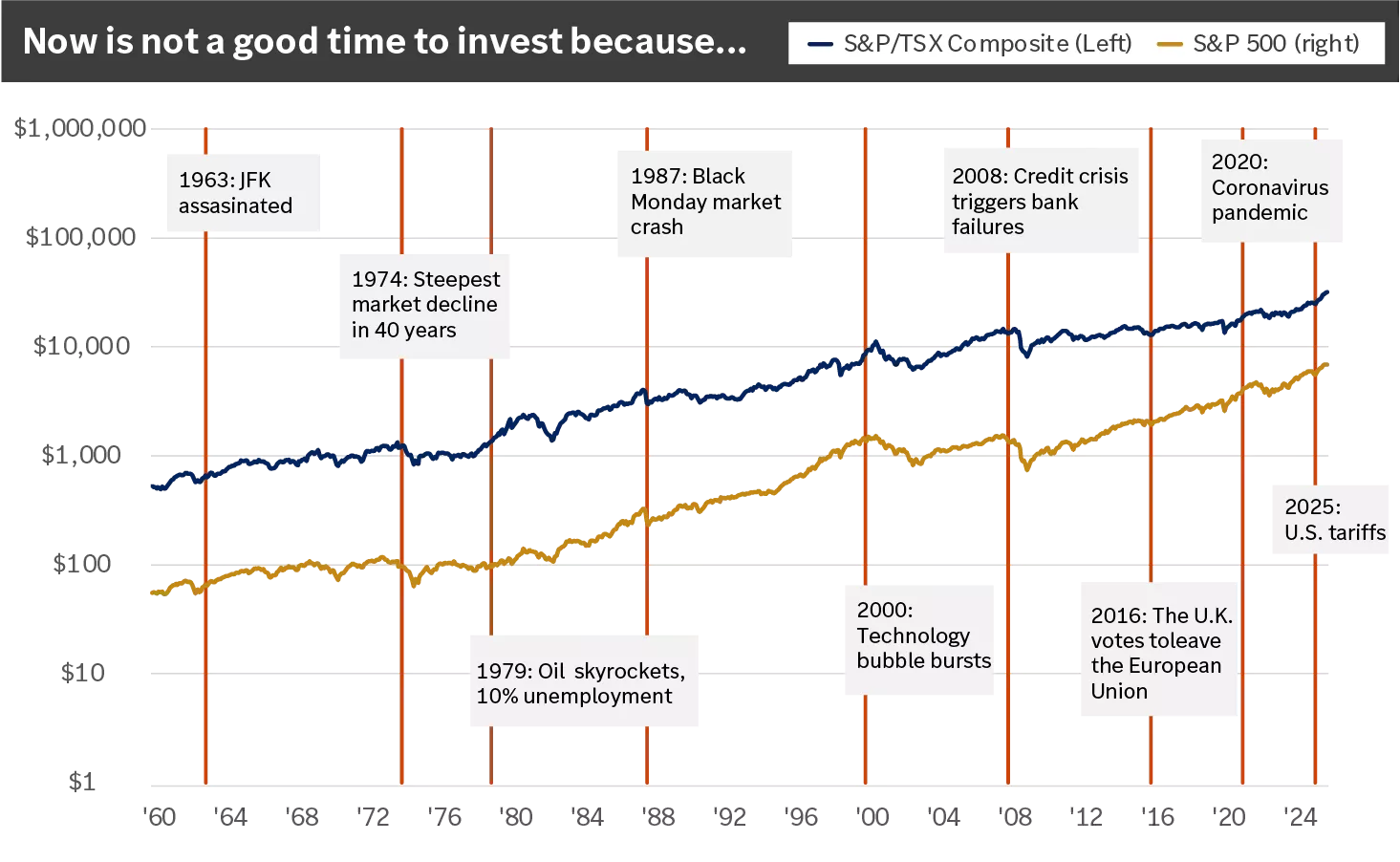
History has presented investors many compelling reasons to stay on the sidelines. Each sparked the same sentiment: "This time is different. This is the worst it's ever been." Yet through all of these challenges, the market has consistently risen over the long term.
The real cost of waiting
When faced with uncertainty, our instinct is often to wait and see how things unfold. The challenge is that the "right time" rarely announces itself.
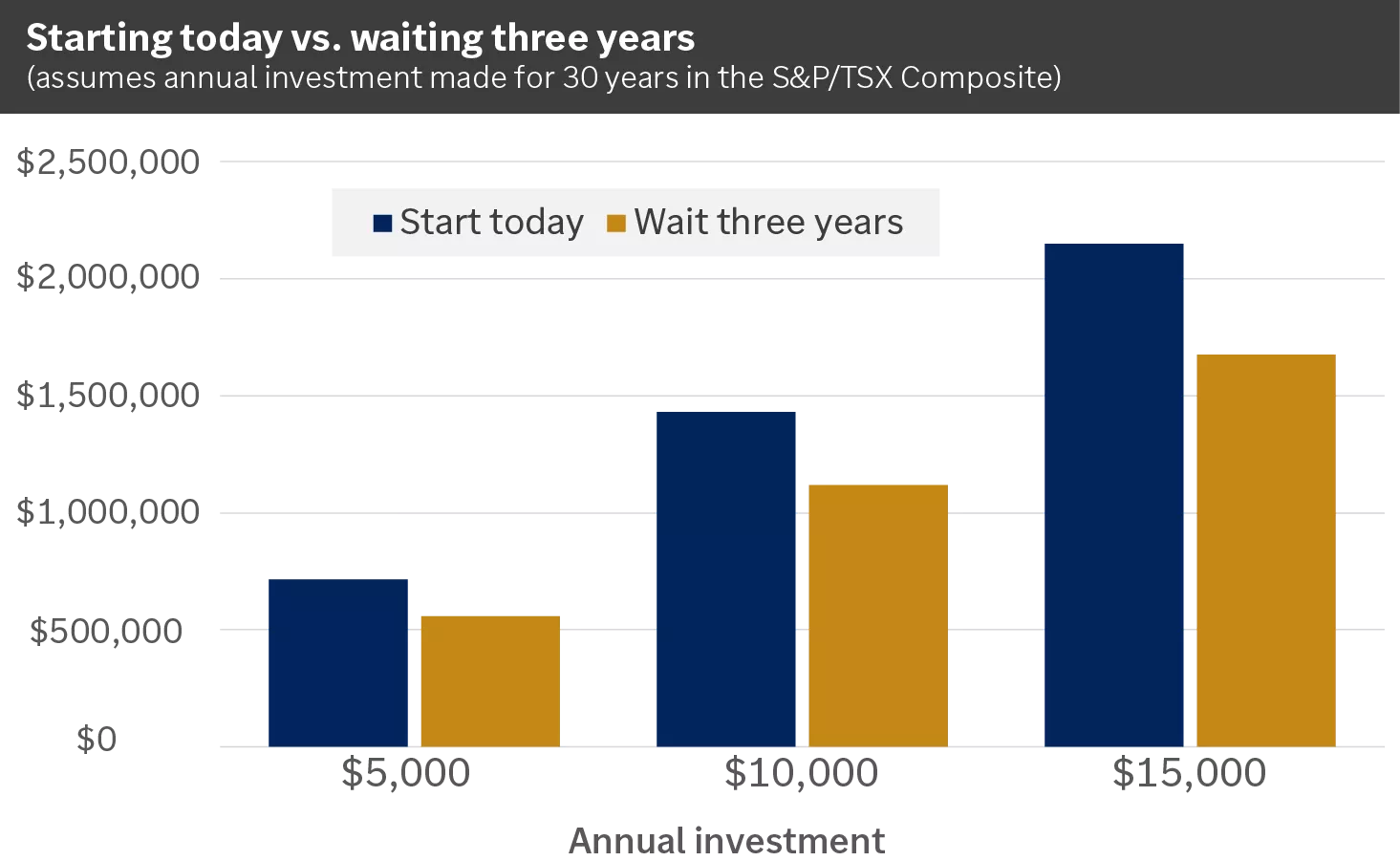
Annual returns of the S&P/TSX Composite Total Return Index, 1/1/1995 - 12/31/2024. Past performance does not guarantee future results. These calculations do not include any commissions or transaction fees that an investor may have incurred. If these fees were included, it would have a negative impact on the return.
Annual returns of the S&P/TSX Composite Total Return Index, 1/1/1995 - 12/31/2024. Past performance does not guarantee future results. These calculations do not include any commissions or transaction fees that an investor may have incurred. If these fees were included, it would have a negative impact on the return.
The math is compelling. An investor who commits to investing annually for 30 years in the S&P/TSX Composite would accumulate significantly more wealth than someone who waits just three years to begin. At higher investment amounts, the gap widens dramatically. Time in the market is one of the most powerful tools available to you. Three years might not seem like much, but compounded over 30 years, those early investment years do substantial work.
Time in the market beats timing the market
Some investors believe they can navigate around uncertainty by stepping out during volatile periods and re-entering when conditions improve. The data suggests this strategy is far riskier than it appears.
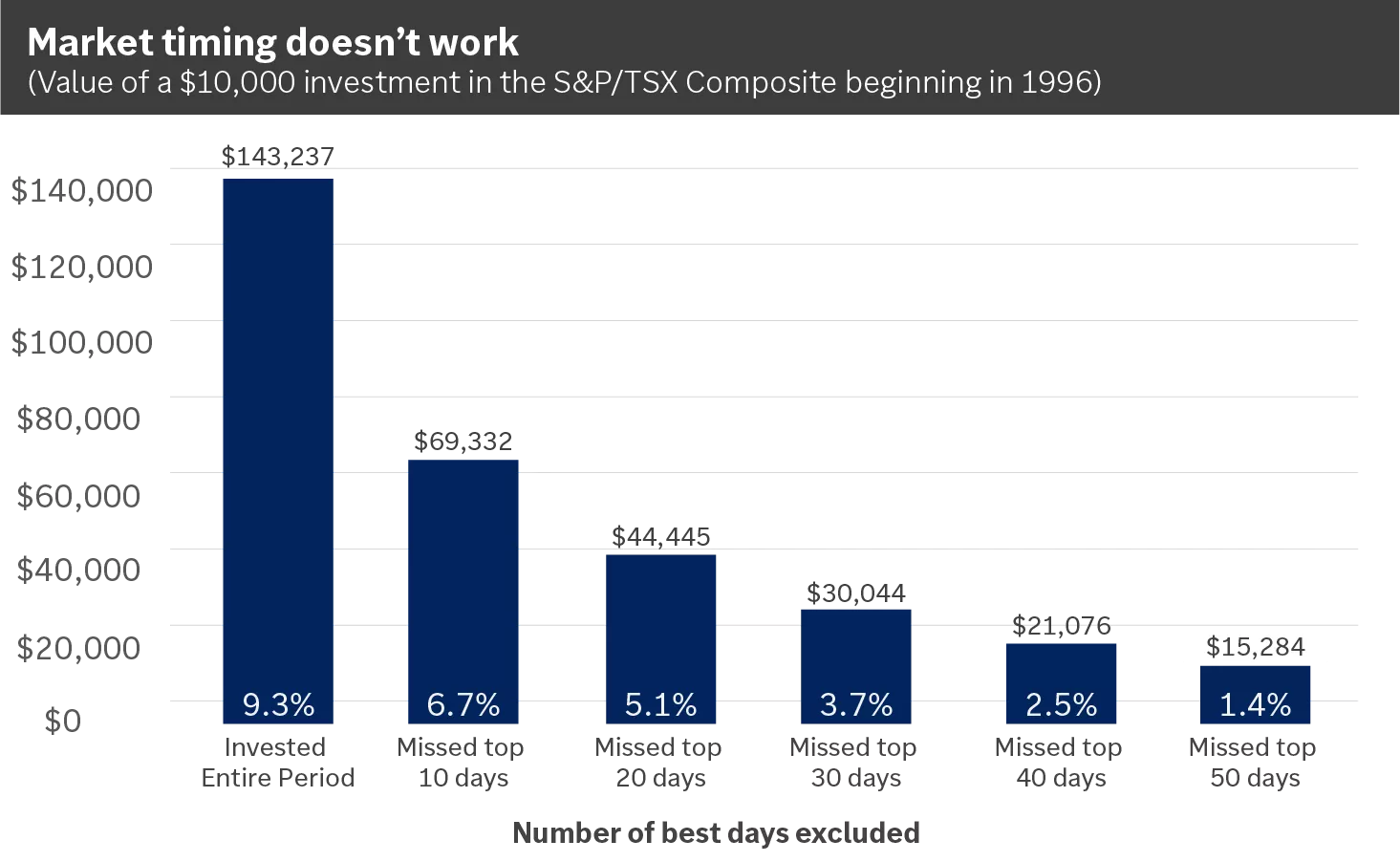
1/1/1995 - 12/31/2024. These calculations assume the best days, as defined as the top percentage gains for the S&P/TSX Composite Total Return Index. Total return includes reinvested dividends. These calculations do not include any commissions or transaction fees that an investor may have incurred. If these fees were included, it would have a negative impact on the return. The S&P/TSX Composite is an unmanaged index and is not available for direct investment. Past performance does not guarantee future results. Dividends can be increased, decreased or eliminated at any point without notice. This is not meant to depict a real investment. Further distribution prohibited without prior permission
1/1/1995 - 12/31/2024. These calculations assume the best days, as defined as the top percentage gains for the S&P/TSX Composite Total Return Index. Total return includes reinvested dividends. These calculations do not include any commissions or transaction fees that an investor may have incurred. If these fees were included, it would have a negative impact on the return. The S&P/TSX Composite is an unmanaged index and is not available for direct investment. Past performance does not guarantee future results. Dividends can be increased, decreased or eliminated at any point without notice. This is not meant to depict a real investment. Further distribution prohibited without prior permission
Missing fifty days out of more than 7,500 trading days (less than 1% of the total time) would cost you over $110,000 on a $10,000 initial investment. The challenge is that the best market days are unpredictable and often occur during periods of greatest uncertainty—precisely when our instincts tell us to stay on the sidelines.
Does this mean there's never a wrong time to invest? Not exactly. Your personal circumstances matter enormously. Your time horizon, financial goals, risk tolerance and financial obligations play a role in determining your strategy. What the data tells us is that waiting for perfect certainty is a risky strategy.
We can help
Investment decisions are deeply personal, and there's no one-size-fits-all answer to whether now is the right time for you to invest. If you're wondering whether now is the right time to invest, or if you're concerned about current market conditions, speak with an Edward Jones advisor.
Important information:
Edward Jones, its employees and financial advisors cannot provide tax or legal advice. You should consult your lawyer or qualified tax advisor regarding your situation. This content should not be depended upon for other than broadly informational purposes. Specific questions should be referred to a qualified tax professional.