Thursday, 3/5/2026 p.m.
- Markets close lower, pressured by climbing oil prices – The TSX and U.S. equity markets finished lower on Thursday, with the pullback led by weakness in consumer staples and materials — sectors that are sensitive to input costs. In international markets, Asia rebounded overnight, while Europe was down. The U.S. dollar strengthened against major currencies, as investors likely seek the stability of the world's reserve currency. Energy markets remain a central focus for investors, as WTI oil briefly topped $80 per barrel for the first time since 2024. Disruptions continue in the Strait of Hormuz, which carries roughly 20% of the world's oil and liquified natural gas (LNG) supply.
Despite near-term volatility, we continue to see opportunities across markets and asset classes. Within equities, we favour U.S. large- and mid-cap stocks, which we believe stand to benefit from their quality and broadening leadership. We also see potential in overseas developed small- and mid-cap and emerging-market equities, supported by resilient global economic growth and relatively attractive valuations. Within fixed income, we think international bonds can add diversification through exposure to different economic and interest-rate cycles, while emerging-market debt may also enhance income.
- Jobless claims unchanged – U.S. initial jobless claims held steady at 213,000 this past week, slightly below the 215,000 expected. Continuing claims — reflecting the total number of people receiving benefits — rose modestly to 1.87 million, suggesting some workers are taking longer to find new employment. Tomorrow's jobs report will offer a deeper look at the labour market, with forecasts calling for a gain of 60,000 jobs for February, enough to keep the unemployment rate steady at 4.3%. We think these trends remain consistent with a stabilizing labour market. Slower job creation alongside a moderate pace of layoffs should help keep wage gains above inflation, in our view, helping provide disposable income to support consumer spending and the economy.
- Bond yields edge higher – Bond yields rose for the fourth straight day, with the 10-year Government of Canada yield at 3.33% and the 10-year U.S. Treasury yield reaching 4.13%. The move primarily reflects expectations that higher inflation — partially influenced by rising oil prices — could delay Fed rate cuts. Markets have pushed expectations for the next rate cut out to September of this year and the second cut to 2027*, aligning with the Fed's latest projections**. In addition, inflation expectations — a key component of bond yields — have risen. Market-implied 10-year inflation expectations in Treasury Inflation Protected Securities (TIPS) markets have climbed about 5 basis points (0.05%) since late last week to roughly 2.3%***. We think the Fed remains positioned to continue cutting rates, though the path may be slower. In our view, the steady labour backdrop should allow policymakers more time to confirm that the Fed's preferred personal consumption expenditures (PCE) inflation — currently 2.9% — is easing sustainably toward the 2% target before proceeding with additional cuts. The Bank of Canada appears to be on hold as well, with the policy rate at the low end of the central bank's own 2.25% - 3.25% estimate for neutral rates****.
Brian Therien, CFA;
Investment Strategy
Source for all data not cited: FactSet.
Sources for data cited: *CME FedWatch **U.S. Federal Reserve ***Federal Reserve Bank of St. Louis ****Bank of Canada
Wednesday, 3/4/2026 p.m.
- Stocks gain on healthy U.S. economic data – North American equity markets closed higher on Wednesday, supported by better‑than‑expected readings from both the ADP employment report and the ISM Services PMI. On the employment front, U.S. private payrolls increased by 63,000 in February, above expectations for a gain of roughly 50,000 and pointing to stabilization in U.S. labour‑market conditions. Additionally, the ISM Services PMI rose to 56.1 in February—well above consensus expectations and the highest reading since July 2022. From a leadership standpoint, most sectors within the S&P 500 finished higher, with growth‑oriented sectors such as technology and consumer discretionary outperforming. Overseas, markets in Asia closed sharply lower overnight, while European markets partially recovered losses from earlier in the week and ended higher. Bond yields rose following the strong U.S. economic data, with the 10‑year U.S. Treasury yield rising to 4.09% and the 10‑year GoC yield reaching 3.26%. In commodity markets, oil prices continued to trend higher amid the ongoing conflict in Iran, with WTI crude closing just above $75 per barrel.
- Oil price spike weighs on overseas stocks – The conflict in Iran has pushed oil prices higher, with WTI crude rising above $70 per barrel for the first time since last summer. Canadian and U.S. equities are modestly lower this week; however, overseas markets have experienced a sharper pullback. The Euro Stoxx 50 has fallen more than 4% this week, while Japan’s Nikkei is down nearly 8%. In emerging markets, Hong Kong’s Hang Seng has declined about 5% this week, and Korea’s KOSPI has fallen 18%. A higher reliance on imported energy in these regions is likely contributing to the more pronounced weakness abroad. According to the World Bank, the euro area imports roughly 68% of its energy consumption, while Japan and Korea import more than 80%; by contrast, Canada and the United States are net exporters of oil*. In our view, the recent pullback in overseas stocks could present an attractive entry point for long‑term investors. Historically, oil price spikes tied to geopolitical conflict have tended to be short‑lived, and the U.S. Energy Information Administration projects global petroleum production to outpace consumption over the next two years, which could limit a sustained rise in prices.** We believe opportunities are particularly compelling in overseas developed small‑ and mid‑cap equities and in emerging‑market equities.
- U.S. private payrolls expanded in February – The February ADP report showed that U.S. private employment rose by 63,000—exceeding expectations for a 50,000 gain and marking the strongest monthly increase since last July. Job growth was broad-based, with gains across goods‑producing industries and service sectors, led by strength in education and health services, Additionally, small businesses—those with 1–19 employees—accounted for the lion’s share of job growth, with payrolls rising by 58,000, the strongest increase since January 2024. In our view, today’s report points to continued stabilization in labour‑market conditions, which should help support economic growth over the course of the year. U.S. labour‑market data remain in focus this week, with February nonfarm payrolls and the unemployment rate due Friday. Expectations are for the unemployment rate to hold at 4.3% and for nonfarm payrolls to increase by 60,000.
Brock Weimer, CFA;
Investment Strategy
Source for all data not cited: FactSet.
Sources for data cited: *World Bank, Energy imports, net (% of energy use) **U.S. Energy Information Administration
Tuesday, 3/3/2026 p.m.
- Markets close lower as investors monitor oil prices – The TSX and U.S. equity markets finished lower on Tuesday after rebounding from a steeper intraday pullback. Asian and European markets also ended down. The U.S. dollar strengthened against major currencies, as investors likely seek the stability of the world's reserve currency. We continue to see opportunities across markets and asset classes, including in areas like cyclical and value sectors, which can hold up better when energy prices rise; U.S. mid-cap stocks, which have more domestic exposure; and emerging markets and parts of international equities, which have exposure to global technology opportunities.
- Oil prices rise further on disruptions – WTI oil prices are up roughly 10% from late last week on supply concerns tied to disruptions to oil production and transportation. Production of both oil and natural gas is being affected by attacks on energy infrastructure, while oil and liquified natural gas (LNG) tankers are being delayed or rerouted amid disruptions in the Strait of Hormuz, a critical chokepoint through which approximately 20% of the world's oil supply passes. President Trump announced measures to provide risk insurance to ships traveling through the region, including oil tankers. In addition, the U.S. Navy will escort ships if necessary. While oil prices could rise further in the near term, similar geopolitical shocks have not produced sustained oil price surges in recent years*.
- Bond yields edge higher – Bond yields rose for the second straight day, with the 10-year Government of Canada yield at 3.24% and the 10-year U.S. Treasury yield at 4.06%. The move appears to be driven primarily by higher inflation expectations — one component of bond yields — likely reflecting rising oil prices. Market-implied 10-year inflation expectations in Treasury Inflation Protected Securities (TIPS) markets have increased about 10 basis points (0.10%) since late last week to about 2.3%. Bond markets also reflect that higher inflation could delay Fed rate cuts. Markets are pricing in expectations for two cuts to the Fed's policy rate later this year to the 3.0% - 3.25% range, followed by one additional cut next year**. This remains a faster pace than the Fed's own projection for one cut this year and another next year***. The Bank of Canada appears to be on hold in the near term as well, in our view.
Brian Therien, CFA;
Investment Strategy
Source for all data not cited: FactSet. Sources for data cited: *U.S. Energy Information Administration **CME FedWatch ***U.S. Federal Reserve
Monday, 3/2/2026 p.m.
Geopolitical worries rise after attack on Iran
The United States and Israel launched an attack on Iran over the weekend, prompting Iran to respond with counterattacks against multiple cities in the Middle East. First and foremost, we know that this is a human tragedy, and there is uncertainty on how long this conflict will last, and what the total loss may look like. As we help our clients navigate this geopolitical crisis, we'll continue to highlight key market perspectives.
Iran is a sizeable oil producer, the fourth largest within OPEC, accounting for roughly 4% of global oil supplies, with about 80% of its exports going to China. The country also sits in a strategically important position: it controls access to the Strait of Hormuz, a critical chokepoint through which approximately 20% of the world’s oil supply passes.
Three Key Market Implications:
1) We believe the biggest impacts may be seen in oil and commodity markets.
We have already seen WTI crude oil move higher about 15% this year, prior to the Iran conflict. And we saw another 6%-plus move higher after the conflict began.
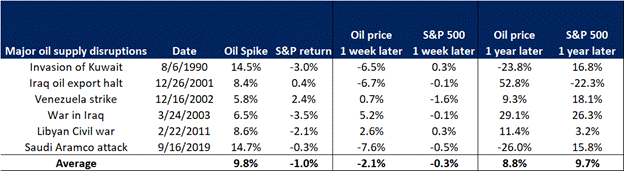
Despite the fluid situation, history offers perspective. Over the past 15 years, similar geopolitical shocks have not produced sustained oil price surges or prolonged market turmoil. Structural changes in the economy also provide resilience:
- The U.S. and Canada have been net petroleum exporters for several years. Energy spending as a share of GDP has declined due to efficiency improvements and a shift toward services.
- The U.S. Energy Information Administration (EIA) reports that the global oil market is currently in significant oversupply, a trend expected to continue through 2026.
- With affordability remaining a key issue ahead of the November mid‑term elections, the administration is likely seeking to prevent a sustained rise in oil prices.
2) Markets may be volatile but are reacting in line with expectations.
Markets began the day sharply lower, but have since recovered, with the S&P 500 and Canadian TSX ending modestly higher on Monday. The S&P 500 is still up about 17% over the past year and remains just 2%-3% below all-time highs. The U.S. dollar was also higher, while global equities closed sharply lower, given most of these economies are more heavily reliant on oil imports than the U.S. or Canada. We also saw some flight-to-safety in precious metals, with spot gold prices up modestly around 1%.
Of note, U.S. and Canadian government bond yields were sharply higher as prices moved lower. This may be in part because there is some fear of higher oil prices leading to higher inflationary pressures. However, this is a more likely scenario only if higher energy prices are sustained for an extended period. Even with WTI now at around $71, prices are below the five-year average of $76. A sustained move to over $100, for example, would present a much more acute disruption in our view, although we are far from these levels and would not expect that outsized move as our base case.
3) Finally, we know geopolitical headlines can create noise and anxiety – staying calm, staying diversified, and staying invested matters.
We know playing politics with portfolios is never a great investment strategy. We continue to see opportunities across markets and asset classes, including in areas like cyclical and value sectors, which can hold up better as energy markets rise; U.S. mid-cap stocks, which have more domestic exposure; and emerging markets and parts of international equities, which have exposure to global technology opportunities.
Bottom line
While the situation remains dynamic, both historical patterns and market fundamentals offer some reassurance. Geopolitical flare‑ups can create volatility, but recent episodes have produced limited and short‑lived market impacts. Your financial advisor can help you make sure you have a solid financial plan and diversified investment strategy in place to navigate uncertainty that may lie ahead.
Mona Mahajan;
Investment Strategy
Source for all data: Bloomberg
The impact of oil shocks on equity and commodity markets tends to be short-lived:
Source: Bloomberg, Edward Jones. Past performance does not guarantee future results. An index is unmanaged, cannot be invested into directly and is not meant to depict an actual investment.
Friday, 2/27/2026 p.m.
- Markets slide at the end of the month – Equities fell today as investors continue to worry over AI disruption, geopolitical strains between the U.S. and Iran, and sticky inflation after stronger-than-expected producer prices data. Weakness was widespread, with the Nasdaq index closing 0.9% lower, the S&P 500 down 0.4%, and the S&P/TSX index also down 0.4% over the session. This followed a mixed tone in global equities overnight, with Asian stocks generally higher, while European markets struggled. Alongside the sell-off in equities, we saw a rally in government bonds, which has helped push the yield on the U.S. 10-year Treasury note below 4% for the first time since November. Meanwhile, the U.S. dollar was softer against a basket of major currencies, and gold prices rallied as markets move to risk-off mode. Finally, oil prices rebounded sharply as traders continue to price in risks of disruptions to global supply from any potential conflict between the U.S. and Iran.
- Canadian GDP fell in the fourth quarter, but underlying growth looks more resilient – Headline Canadian GDP dropped 0.6% annualized over the fourth quarter, undershooting consensus expectations for a modest increase. However, the details of the report were less concerning in our view, with the headline miss largely driven by a rundown in inventories, which have been volatile in the wake of trade tensions with the U.S. Looking aside from these, household spending was up 1.7% in annualized terms, representing stronger growth than suggested by weaker retail-sales readings. Meanwhile, fiscal stimulus is starting to feed through to the economy, with government consumption up an even more robust 3.1% annualized. Finally, while residential investment remains soft, there were more encouraging signs from other types of business investment over the quarter. Overall, while trade tensions continue to weigh on the economy, underlying growth in Canada looks resilient to us. We think this should encourage the Bank of Canada to leave interest rates on hold at 2.25%, with these helping provide moderate support to the economy at present.
- Signs of tariff pressures in producer price index (PPI) data – Headline producer prices were up a stronger-than-expected 0.5% over the month of January, comfortably beating expectations for a 0.3% gain. Driving this upside surprise was an increase in services prices in the wholesale and retail sector, with this effectively capturing higher margins charged by these companies. In practice, this likely reflects firms increasingly looking to pass through some of the higher input prices they see due to tariffs, in our view. There were also signs of tariff inflation in goods prices, which were up 0.7% when we exclude volatile food and energy prices. Overall, the PPI report points to some continued pipeline tariff pressures, which we expect to persist through still elevated inflation over the first half of 2026. PPI data also provide several key inputs into the Fed's preferred personal consumption expenditure (PCE) inflation report for January, which has been running hotter than the consumer price index (CPI) data in recent months. These signs of sticky inflation in early 2026 should keep the Fed on hold through the first half of the year in our view, before some cooling helps create space for one or two more cuts later in 2026.
- A strong February in bond markets – Today's rally in U.S. bond markets has helped close a strong month for Treasuries, with 10-year yields down a full 25 basis points (0.25%), representing the largest monthly gain in a year. Bonds have enjoyed safe-haven-driven inflows as investors worry about geopolitical tensions in the Middle East and AI disruptions in the equity markets and have been reassured around Fed independence by the nomination of Kevin Warsh as the next Fed chair. However, we think yields will struggle to make progress from here for a couple of reasons. First, we don't see room for the market to price additional near-term rate cuts absent any unexpected deterioration in the economic outlook. Second, we are mindful around some of the long-term concerns around rising U.S. Treasury supply due to higher debt and deficits, and potentially lower Fed Treasury holdings if new Fed chair Warsh gets his way. Overall, we continue to expect the 10-year U.S. Treasury yield to generally trade in a 4%-4.5% range this year.
James McCann;
Investment Strategy
Source for all data: Bloomberg, FactSet