Monday, 3/2/2026 p.m.
Geopolitical worries rise after attack on Iran
The United States and Israel launched an attack on Iran over the weekend, prompting Iran to respond with counterattacks against multiple cities in the Middle East. First and foremost, we know that this is a human tragedy, and there is uncertainty on how long this conflict will last, and what the total loss may look like. As we help our clients navigate this geopolitical crisis, we'll continue to highlight key market perspectives.
Iran is a sizeable oil producer, the fourth largest within OPEC, accounting for roughly 4% of global oil supplies, with about 80% of its exports going to China. The country also sits in a strategically important position: it controls access to the Strait of Hormuz, a critical chokepoint through which approximately 20% of the world’s oil supply passes.
Three Key Market Implications:
1) We believe the biggest impacts may be seen in oil and commodity markets.
We have already seen WTI crude oil move higher about 15% this year, prior to the Iran conflict. And we saw another 6%-plus move higher after the conflict began.
Despite the fluid situation, history offers perspective. Over the past 15 years, similar geopolitical shocks have not produced sustained oil price surges or prolonged market turmoil. Structural changes in the economy also provide resilience:
- The U.S. and Canada have been net petroleum exporters for several years. Energy spending as a share of GDP has declined due to efficiency improvements and a shift toward services.
- The U.S. Energy Information Administration (EIA) reports that the global oil market is currently in significant oversupply, a trend expected to continue through 2026.
- With affordability remaining a key issue ahead of the November mid‑term elections, the administration is likely seeking to prevent a sustained rise in oil prices.
2) Markets may be volatile but are reacting in line with expectations.
Markets began the day sharply lower, but have since recovered, with the S&P 500 and Canadian TSX ending modestly higher on Monday. The S&P 500 is still up about 17% over the past year and remains just 2%-3% below all-time highs. The U.S. dollar was also higher, while global equities closed sharply lower, given most of these economies are more heavily reliant on oil imports than the U.S. or Canada. We also saw some flight-to-safety in precious metals, with spot gold prices up modestly around 1%.
Of note, U.S. and Canadian government bond yields were sharply higher as prices moved lower. This may be in part because there is some fear of higher oil prices leading to higher inflationary pressures. However, this is a more likely scenario only if higher energy prices are sustained for an extended period. Even with WTI now at around $71, prices are below the five-year average of $76. A sustained move to over $100, for example, would present a much more acute disruption in our view, although we are far from these levels and would not expect that outsized move as our base case.
3) Finally, we know geopolitical headlines can create noise and anxiety – staying calm, staying diversified, and staying invested matters.
We know playing politics with portfolios is never a great investment strategy. We continue to see opportunities across markets and asset classes, including in areas like cyclical and value sectors, which can hold up better as energy markets rise; U.S. mid-cap stocks, which have more domestic exposure; and emerging markets and parts of international equities, which have exposure to global technology opportunities.
Bottom line
While the situation remains dynamic, both historical patterns and market fundamentals offer some reassurance. Geopolitical flare‑ups can create volatility, but recent episodes have produced limited and short‑lived market impacts. Your financial advisor can help you make sure you have a solid financial plan and diversified investment strategy in place to navigate uncertainty that may lie ahead.
Mona Mahajan;
Investment Strategy
Source for all data: Bloomberg
The impact of oil shocks on equity and commodity markets tends to be short-lived:
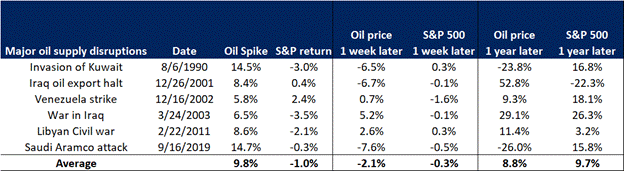
Source: Bloomberg, Edward Jones. Past performance does not guarantee future results. An index is unmanaged, cannot be invested into directly and is not meant to depict an actual investment.
Friday, 2/27/2026 p.m.
- Markets slide at the end of the month – Equities fell today as investors continue to worry over AI disruption, geopolitical strains between the U.S. and Iran, and sticky inflation after stronger-than-expected producer prices data. Weakness was widespread, with the Nasdaq index closing 0.9% lower, the S&P 500 down 0.4%, and the S&P/TSX index also down 0.4% over the session. This followed a mixed tone in global equities overnight, with Asian stocks generally higher, while European markets struggled. Alongside the sell-off in equities, we saw a rally in government bonds, which has helped push the yield on the U.S. 10-year Treasury note below 4% for the first time since November. Meanwhile, the U.S. dollar was softer against a basket of major currencies, and gold prices rallied as markets move to risk-off mode. Finally, oil prices rebounded sharply as traders continue to price in risks of disruptions to global supply from any potential conflict between the U.S. and Iran.
- Canadian GDP fell in the fourth quarter, but underlying growth looks more resilient – Headline Canadian GDP dropped 0.6% annualized over the fourth quarter, undershooting consensus expectations for a modest increase. However, the details of the report were less concerning in our view, with the headline miss largely driven by a rundown in inventories, which have been volatile in the wake of trade tensions with the U.S. Looking aside from these, household spending was up 1.7% in annualized terms, representing stronger growth than suggested by weaker retail-sales readings. Meanwhile, fiscal stimulus is starting to feed through to the economy, with government consumption up an even more robust 3.1% annualized. Finally, while residential investment remains soft, there were more encouraging signs from other types of business investment over the quarter. Overall, while trade tensions continue to weigh on the economy, underlying growth in Canada looks resilient to us. We think this should encourage the Bank of Canada to leave interest rates on hold at 2.25%, with these helping provide moderate support to the economy at present.
- Signs of tariff pressures in producer price index (PPI) data – Headline producer prices were up a stronger-than-expected 0.5% over the month of January, comfortably beating expectations for a 0.3% gain. Driving this upside surprise was an increase in services prices in the wholesale and retail sector, with this effectively capturing higher margins charged by these companies. In practice, this likely reflects firms increasingly looking to pass through some of the higher input prices they see due to tariffs, in our view. There were also signs of tariff inflation in goods prices, which were up 0.7% when we exclude volatile food and energy prices. Overall, the PPI report points to some continued pipeline tariff pressures, which we expect to persist through still elevated inflation over the first half of 2026. PPI data also provide several key inputs into the Fed's preferred personal consumption expenditure (PCE) inflation report for January, which has been running hotter than the consumer price index (CPI) data in recent months. These signs of sticky inflation in early 2026 should keep the Fed on hold through the first half of the year in our view, before some cooling helps create space for one or two more cuts later in 2026.
- A strong February in bond markets – Today's rally in U.S. bond markets has helped close a strong month for Treasuries, with 10-year yields down a full 25 basis points (0.25%), representing the largest monthly gain in a year. Bonds have enjoyed safe-haven-driven inflows as investors worry about geopolitical tensions in the Middle East and AI disruptions in the equity markets and have been reassured around Fed independence by the nomination of Kevin Warsh as the next Fed chair. However, we think yields will struggle to make progress from here for a couple of reasons. First, we don't see room for the market to price additional near-term rate cuts absent any unexpected deterioration in the economic outlook. Second, we are mindful around some of the long-term concerns around rising U.S. Treasury supply due to higher debt and deficits, and potentially lower Fed Treasury holdings if new Fed chair Warsh gets his way. Overall, we continue to expect the 10-year U.S. Treasury yield to generally trade in a 4%-4.5% range this year.
James McCann;
Investment Strategy
Source for all data: Bloomberg, FactSet
Thursday, 2/26/2026 p.m.
- Markets mixed as investors assess strong NVIDIA results – The TSX reached a new record high, while U.S. equity markets edged lower on Thursday, led by a pullback in technology stocks. Despite NVIDIA reporting fourth-quarter results that beat analyst estimates, we think the move partly reflects questions about the durability of elevated AI-related capital spending. Bond yields fell, with the 10-year Government of Canada yield at 3.17% and the 10-year U.S. Treasury yield at 4.01%. In international markets, Asia finished mixed overnight, while Europe was little changed. In commodities, WTI oil was about flat as U.S.-Iran tensions likely offset a U.S. Energy Information Administration report showing higher U.S. crude inventories.
- NVIDIA adds to a solid earnings season – AI leader NVIDIA reported results ahead of forecasts and raised guidance for first-quarter revenue. More broadly, earnings have exceeded expectations: with nearly 95% of S&P companies reporting, 75% have beaten estimates, with an average upside surprise of 7.3%. Consequently, earnings growth estimates have risen to 11.9%, from 7.2% at quarter-end. Growth has been broad-based as well, with all 11 sectors on track to post higher earnings, led by technology with over 30% growth. We expect robust, expansive earnings growth to support a broadening of market leadership. Profit growth is expected to accelerate through 2026, with estimates pointing to a roughly 14% rise in earnings for the year. With valuations elevated relative to history, we believe continued earnings growth will be essential for further stock‑market upside. We recommend overweighting stocks relative to bonds within a globally diversified allocation. We see opportunities in U.S. large- and mid-cap stocks, developed international small- and mid-cap stocks, and emerging-market equities.
- Jobless claims rise modestly, as expected – U.S. initial jobless claims ticked up to 212,000 this past week from 208,000 the prior week, in line with estimates. Continuing claims — reflecting the total number of people receiving benefits — dipped to 1.83 million, slightly below forecasts to hold roughly steady. Job openings contracted to 6.5 million in December, compared with unemployment of 7.4 million. With the unemployment rate still low at 4.3%, we view these data as consistent with a stabilizing labour market characterized by slower hiring and layoffs. We believe a steady labour backdrop should help give the Fed time to confirm that headline personal consumption expenditures (PCE) inflation — currently 2.9% — is easing toward the 2% target before considering further rate cuts. Bank of Canada appears to be on hold for the time being as well, with the policy rate at the low end of the bank's own 2.25%-3.25% estimate for neutral rates.
Brian Therien, CFA;
Investment Strategy
Source for all data: FactSet
Wednesday, 2/25/2026 p.m.
- Stocks gain with earnings in focus – North American equity markets closed higher Wednesday, as investors await earnings results from NVIDIA after today’s market close.* In Canada, Bank of Montreal and National Bank of Canada reported better-than-expected earnings and revenue this morning, supporting shares and the broader financials sector of the TSX.* South of the border, financials and technology were among the top performers, regaining ground after AI disruption concerns have weighed on these sectors in recent weeks.* Overseas, European markets traded higher, and Asian markets closed higher overnight, led by Japan’s Nikkei, which gained over 2%.* Bond yields were slightly higher Wednesday, with the 10‑year U.S. Treasury closing at 4.05% and the 10‑year GoC at 3.19%.*
- All eyes on NVIDIA earnings – Corporate earnings remain in focus on Wednesday, with investors awaiting results from tech giant NVIDIA after the market close today.* Analysts expect quarterly revenue of $66 billion—nearly 70% higher than a year ago—while EPS is expected to be $1.54, up 73% year-over-year if achieved.* In Canada, Bank of Montreal and National Bank of Canada reported better-than-expected earnings and revenue this morning, following an earnings beat from Bank of Nova Scotia on Tuesday.* At the index level, nearly 60% of companies in the TSX have reported fourth-quarter results, with earnings on pace to grow by 16% year-over-year.* In the U.S., 90% of companies in the S&P 500 have reported fourth-quarter results, with earnings on pace to grow by roughly 12% year-over-year—the fifth consecutive quarter of double-digit earnings growth, if it holds.* In 2026, earnings growth is expected to remain strong, with analysts calling for growth of 16% for the TSX and 14% for the S&P 500*. Despite recent market volatility, we believe the fundamental backdrop for equity markets remains supportive, underpinned by steady economic and corporate profit growth.*
- Overseas momentum has continued in 2026 – After a strong 2025, overseas equities have extended their momentum into 2026 and are outperforming Canadian and U.S. markets year‑to‑* Emerging‑market equities are leading: the MSCI Emerging Markets Index is up more than 13% year‑to‑date in Canadian dollar terms.* While the technology sector has lagged in Canada and the U.S., tech‑heavy regions such as Korea and Taiwan have posted strong gains year‑to‑date—approximately 47% and 22%, respectively—supporting the broader emerging‑markets index.* In developed markets, the MSCI EAFE Index is up more than 8% in 2026, aided by strength in Japan, where MSCI Japan has gained over 12% amid expectations for potential fiscal easing and an improvement in manufacturing activity, as the preliminary S&P Global Japan Manufacturing PMI rose to a near four‑year high in February.* We believe the global backdrop remains supportive for equities, and we recommend a globally diversified overweight to stocks versus bonds. In particular, we see opportunities in U.S. stocks, overseas developed small‑ and mid‑caps, and emerging‑market equities.
Brock Weimer, CFA;
Investment Strategy
Source: *FactSet
Tuesday, 2/24/2026 p.m.
- Stocks rise, helped by tech rebound - Major North American equity indexes finished higher as sentiment around technology and AI showed early signs of stabilizing*. AMD gained roughly 8% following news of a multiyear partnership with Meta, while software stocks advanced after AI startup Anthropic announced new integrations that position its tools as complements to existing systems rather than replacements*. In Canada, Scotiabank shares traded slightly lower following its earnings report, though this comes after a roughly 50% gain over the past 12 months*. For the remainder of the week, investor attention will likely center on the evolving impact of AI across industries, NVIDIA’s earnings tomorrow, new trade considerations following the U.S. Supreme Court decision, and ongoing geopolitical developments. Oil prices continued to hover near seven‑month highs, marking their strongest start to a year since 2022, amid rising U.S.–Iran tensions*. Meanwhile, government bonds have benefited from February’s volatility and safe‑haven demand, pushing the 10‑year GoC yield down to 3.18%.*.
- AI disruption fears linger - While some concerns may ultimately prove overblown, several industries continue to face valuation pressures tied to AI‑driven disruption fears. The technology sector remains at the center, with the S&P 500 software industry down roughly 32% from its October peak*, though the group is seeing a rebound today. The pace of new AI tools and agent releases continues to accelerate, and we think the fast‑moving environment will inevitably create both winners and losers. Historically, major technological advances have driven productivity gains, faster economic growth, and rising living standards—even if the process of creative destruction can be messy. In the meantime, the rotation toward “old‑economy” areas of the market such as energy, materials, staples, and industrials is helping add resilience to diversified portfolios*. The next key catalyst for AI sentiment arrives Wednesday, when NVIDIA reports earnings after the market close.
- Markets weigh trade developments - Last week’s Supreme Court decision to strike down the U.S. administration’s global tariffs has introduced a new wave of uncertainty around trade policy. On one hand, the effective tariff rate appears set to move lower, offering a form of short‑term fiscal stimulus*. Overnight, U.S. Customs and Border Protection implemented a new 10% global tariff, less than the 15% rate President Trump had pledged, though the higher rate may still come later*. On the other hand, the administration has reiterated its commitment to reconstructing the prior tariff framework and is exploring alternative legal paths to reinstate tariffs*. This uncertainty around the rules and the status of potential refunds may lead some businesses to delay spending and hiring decisions. Still, as last year's experience showed, the broader economy has proven resilient*. For Canada, we don't think the new 15% global tariff rate will have a meaningful impact on the economy, as the CUSMA-compliant goods are exempt from tariffs and the Section 232 tariffs on steel, aluminum and lumber are not changed*. We continue to advise investors not to overreact to shifting headlines and to maintain a constructive outlook supported by steady economic growth and rising corporate earnings.
Angelo Kourkafas, CFA;
Investment Strategy
Source: *FactSet