SoYoung Kim, CFP®, CLU® ; Senior Wealth Consultant, Client Consultation Group
Your business is more than just a livelihood to you and your loved ones—it’s a legacy shaped by years of hard work and commitment. Protecting what you’ve built and passing the torch to trusted family members or successors is a pivotal moment in your business journey. With the right planning and strategic guidance, it can be a smooth transition. Strategic guidance from a team of professionals, including a Financial Advisor, helps to safeguard the future—preserving your wealth and the business for those who will carry it forward.
What's a business succession plan
A business succession plan is a guide for what happens when you step away from your business for any reason including retirement, a sale, or unexpected circumstances like illness. It's more than just a retirement strategy; It defines who will take over, how the transition will unfold, and what steps are needed to help ensure continuity and stability.
Why business succession planning matters
A well-crafted business succession plan can help:
- Support business continuity even during unexpected challenges like illness, disability, or leadership changes.
- Prepare future leaders by identifying successors early and equipping them with targeted training, mentoring and exposure to strategic decision-making.
- Minimize disruptions for your employees and clients by creating a clear transition strategy.
- Protect the value of your business by building the right team early, reducing uncertainties, and avoiding costly mistakes.
- Secure your family’s financial future by uncovering opportunities to grow business value before the transition.
- Maintain family harmony by aligning expectations and reducing the risk of misunderstandings down the road.
The risk of delaying your business succession plan
Succession planning often takes a back seat—whether it’s because the business doesn't feel ready, the right successor hasn't been identified, or it's unclear where to begin. It’s easy to postpone these conversations, especially when your business feels like an extension of yourself. But without a plan, uncertainty can affect your business, employees, and family’s financial future.
Despite its importance, only 9% of Canadian business owners have a formal business succession plan in place1 —even though most recognize its value. The good news is, you don't have to do it alone. Your advisory network—including a financial advisor—can help you start and guide you through the process. Ideally, planning should begin at least five years in advance, and even earlier if complex family dynamics are involved.
How to build your business succession plan
While every business is unique, most succession plans are built around a few essential components. These elements don’t always follow a strict order, but they serve as a foundation for creating a plan that reflects your goals and protects what you’ve worked so hard to build. Let’s take a closer look at each component, designed to help you:
Business succession plan tax and legal considerations
Understanding the following key areas can help you navigate the complexities and make informed decisions as you build your plan.
Lifetime capital gains exemption (LCGE) in business succession planning
What Is the lifetime capital gains exemption (LCGE)?
The LCGE is a valuable tax benefit available to individual Canadian residents. It allows you to reduce or eliminate capital gains tax on the sale of Qualified Small Business Corporation Shares (QSBCS) and Qualified farm or fishing property. As of June 25, 2024, the LCGE has increased to $1.25 million2.
When can you use LCGE?
You may be eligible to claim the LCGE when:
- You sell shares of your corporation
- You implement an estate freeze, transferring future growth to a successor
Does your corporation qualify for LCGE?
To claim the LCGE, your shares need to meet the Qualified Small Business Corporation (QSBC) criteria3:
- Small Business Corporation Test4
- The corporation needs to be a Canadian-Controlled Private Corporation (CCPC).
- At least 90% of its assets need to be used in an active business in Canada at the time of sale.
- Holding Period Ownership Test5
- Shares need to be owned by you (or a related person like a spouse, child) for at least 24 months before the sale.
- Shares need to be owned by you (or a related person like a spouse, child) for at least 24 months before the sale.
- Holding Period Asset Test6
- For the 24 months before the sale, more than 50% of the corporation’s assets needs to be used principally in an active business.
- For the 24 months before the sale, more than 50% of the corporation’s assets needs to be used principally in an active business.
What if your business doesn’t qualify for LCGE?
If your corporation holds too many non-active business assets (e.g., excess cash, investments), you may be able to “purify” it by removing these assets to meet the LCGE requirements. A qualified tax advisor can help you determine which assets to remove and how best to restructure your corporation.
Estate freeze
What Is an estate freeze?
An estate freeze is a widely used strategy in Canadian tax and estate planning. It allows you to lock in the current value of your business, shifting future growth to your successor—typically your children. This can reduce the tax burden on your estate and support a more efficient transfer of wealth.
How does an estate freeze work?
- The current owner (e.g., parent) typically initiates "the freeze" by exchanging their common shares for preferred shares with a fixed value. The preferred shares can retain voting rights, allowing the owners to maintain control of the business after the freeze.
- New common shares are then issued to the successor (e.g., children, trust) at a nominal value.
- From that point forward, future growth in the business accrues to the new common shareholders – your successor, not the original owner.
Benefits of an estate freeze
- Minimize or defer capital gains taxes by locking in the current value of your shares.
- Create income-splitting opportunities with family members.
- Multiply the use of the Lifetime Capital Gains Exemption (LCGE) across multiple shareholders.
- Reduce probate fees by lowering the value of the estate subject to probate
Example: Julia and Adam’s estate freeze
Julia and Adam are co-owners of XYZ Mechanic Inc., a business currently valued at $6 million. Each holds 50 common shares with a nominal cost base of $50. As they plan to retire in the next 10 years, they want to transition ownership to their son, Adam Jr., who is already actively involved in the business. They are also concerned about the future tax burdens as their business continues to grow.
With guidance from their accountant, they implement an estate freeze:
Exchange of shares:
Julia and Adam exchange their common shares for preferred shares valued at $6 million, retaining voting rights, allowing them to maintain control during the transition. These shares have a fixed value and do not participate in future growth.
Issuance of new shares:
Adam Jr. purchases new common shares for $100. These shares are issued at a nominal value and will capture all future growth of the business.
From this point forward, any increase in the value of XYZ Mechanic Inc. accrues to Adam Jr., effectively freezing Julia and Adam’s estate at $6 million
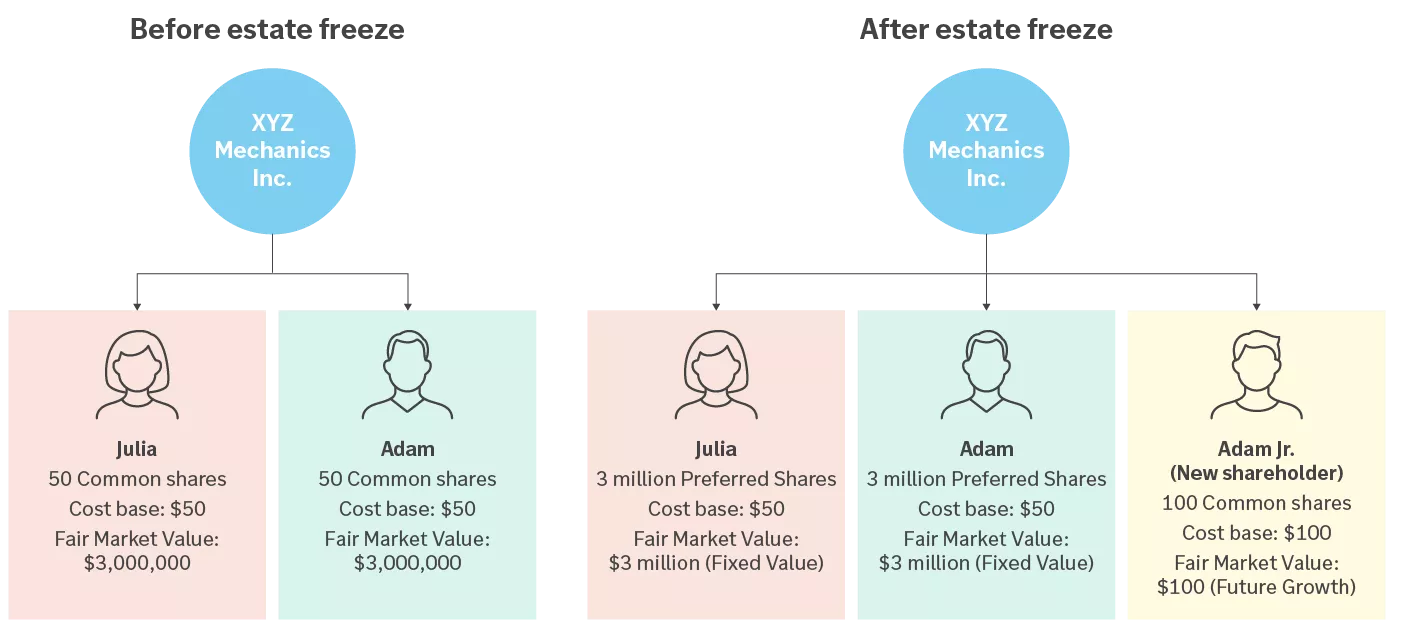
This example illustrates a simplified estate freeze. In more advanced structures, it may involve holding companies or family trusts to achieve additional tax and estate planning objectives. Like any tax strategy, an estate freeze can have unintended consequences if not properly planned and executed. It's essential to consult a qualified tax advisor to determine the best approach for your specific situation and goals.
Selling your business: Assets vs. shares
If your succession plan includes selling your business, one of the most important decisions is whether to sell assets or shares. Each option carries distinct legal, financial, and tax implications, and the most most suitable choice depends on your goals, the structure of your business, and the preferences of the buyer.
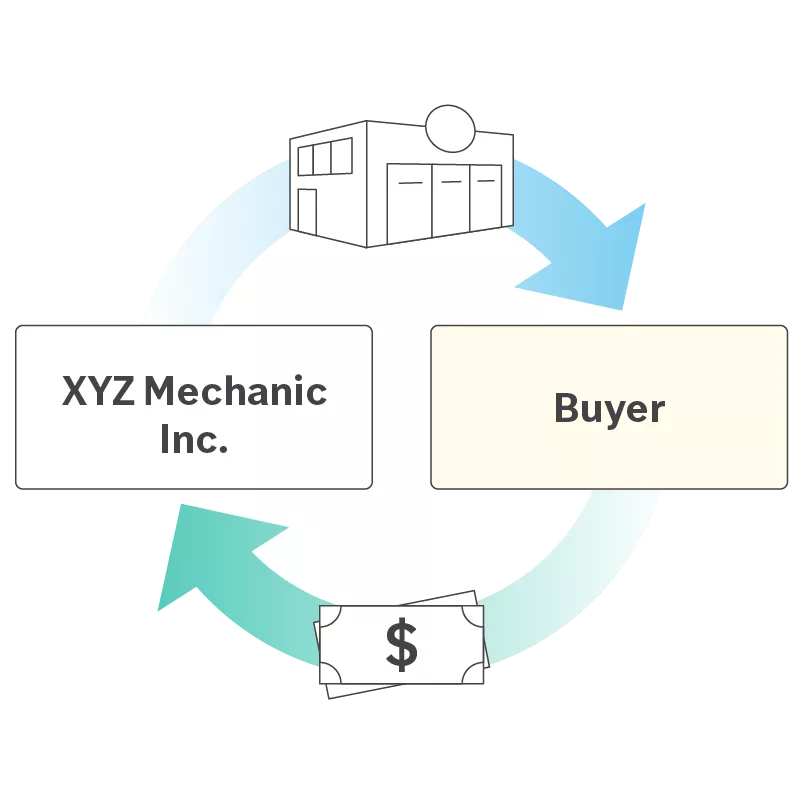
Asset sale
- The corporation sells specific assets (e.g., equipment, land, licenses, inventory).
- The seller remains the owner of the corporation but no longer owns the assets sold.
Example: If Julia and Adam sell XYZ Mechanic Inc.'s shop and equipment, they still own the shares of XYZ Mechanic Inc. after the sale. Julia and Adam will need to explore how to withdraw funds from XYZ Mechanic Inc., once the sale is complete.
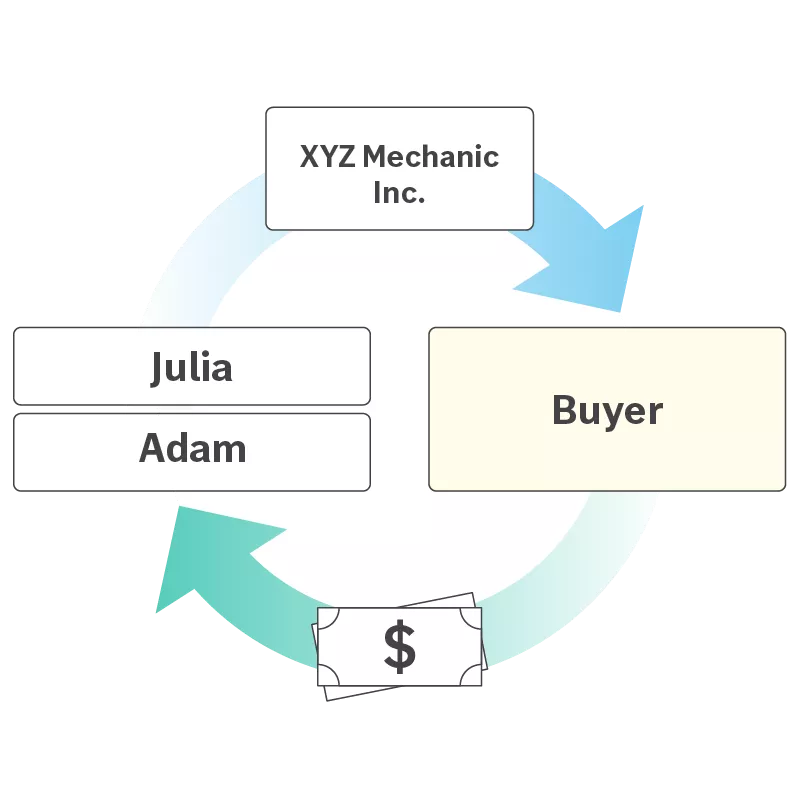
Share sale
- The buyer purchases the shares of the corporation.
- The buyer becomes the legal owner of the corporation, including its assets and liabilities.
Example: If Julia and Adam sell all their shares of XYZ Mechanic Inc., they no longer own XYZ Mechanic Inc., after the sale.
Comparing asset sale vs. share sale
| Factor | Asset sale | Share sale |
|---|---|---|
| Unwanted assets | You may be left with assets the buyer doesn’t want, which could be hard to sell. | All assets transfer to the buyer, so you’re not left with anything unwanted. |
| Liabilities | You remain responsible for liabilities not taken by the buyer (e.g., future tax reassessments or lawsuits). | Liabilities generally stay with the corporation and become the buyer’s responsibility. |
| Complexity | More complex: usually involves two levels of tax—corporate and personal. | Less complex: if the seller is an individual, only one level of tax applies. |
| Tax benefit | You cannot claim the Lifetime Capital Gains Exemption. | You can claim the Lifetime Capital Gains Exemption if the conditions are met. |
Shareholder agreement
As part of your succession plan, it’s essential to review your shareholder agreement—or determine whether one should be created. This agreement sets the rules for what happens if an owner retires, becomes disabled, passes away, or wants to sell their shares.
Without a clear agreement, disputes can arise, causing delays and financial stress for the business and its stakeholders.
What to include:
- Buy-Sell provisions: Who can buy shares and under what conditions.
- Valuation method: How the business will be valued for a sale or transfer.
- Funding arrangements: How the purchase will be financed (often through life insurance).
- Roles and responsibilities: Expectations for owners during and after the transition.
A well-drafted shareholder agreement provides clarity, protects relationships, and helps ensure a smoother transition- especially in closely held or family-run businesses.
Next steps
Business succession planning isn’t just about preparing for retirement—it’s about protecting what you’ve built and helping to ensure a smooth transition for your business, your employees, and your family. It also means navigating emotional complexities, managing relationships, and coming to terms with letting go of control.
You can help ensure that your future is as successful as your present by working with an Edward Jones Financial Advisor.
If you’re a business owner in Canada, consult with qualified tax and legal professionals before acting on this information. A financial advisor can also play a key role in helping you build, preserve, and transfer your wealth effectively.
Important information
Edward Jones, its employees and financial advisors, cannot provide tax or legal advice. You should consult your lawyer or qualified tax advisor regarding your situation or any specific questions you may have.
1 Succession Tsunami: Preparing for a decade of small business transitions in Canada, Jan 10, 2023
2 https://www.canada.ca/en/revenue-agency/services/tax/individuals/topics…
3 Subsection 110.6(1) of the ITA
4 Subsection 248(1) of the ITA.
5 Subsection 110.6(1) of the ITA
6 Subsection 110.6(1) of the ITA