A roller-coaster week for rates: Separating opportunity from risk
Key takeaways
- Upward pressure on global long-term bond yields weighed on investor sentiment, sending stocks lower last week.
- Although the U.S. Treasury Department’s buyback announcement briefly pushed yields lower, the broader forces that we see driving yields higher remain in place. We continue to expect the 10-year GoC yield to trade between 3.5% and 4% and the 10-year U.S. Treasury yield to trade between 4.5% and 5.0% over the remainder of the year.
- Higher yields have improved the multiyear return outlook for investment-grade bonds by increasing their income potential. However, with yields likely to remain range-bound in the near term, price appreciation may be limited, in our view.
- August and September have historically been seasonally weaker months for stocks, and uncertainty could rise as the U.S. midterm elections approach. While a period of near-term consolidation would not be surprising to us, resilient economic activity and strong corporate profit growth underpin a constructive backdrop for equities over the next 12 months, in our view.
After a strong earnings season helped lift North American equity markets to record highs in August, stocks took a breather last week as the bond market moved to centre stage. Rising long-term U.S. yields raised concerns about whether the economy and financial markets could continue to withstand higher borrowing costs, particularly as the 30-year U.S. Treasury yield reached its highest level since 2007 early in the week. With Canadian and U.S. financial markets closely intertwined, longer-term Canadian government bond yields also traded higher last week.
Perhaps most surprising is that the latest rise in long-term yields has come on the heels of a weak July U.S. payrolls report, moderating inflation data, and reduced expectations for Federal Reserve rate hikes, conditions that would ordinarily place downward pressure on yields.
The rise in long-term yields without a clear macroeconomic driver also caught policymakers’ attention. The U.S. Treasury Department announced that it would increase the size of its long-term Treasury buybacks beginning next month. Following the announcement, the 30-year Treasury yield fell by 0.1 percentage points on Wednesday, its largest one-day decline in more than a year. However, the reprieve proved short-lived, as long-term yields recouped much of the decline over the remainder of the week.
In this week’s report, we unpack the forces putting upward pressure on longer-term yields and assess what they could mean for the economy and investor portfolios.
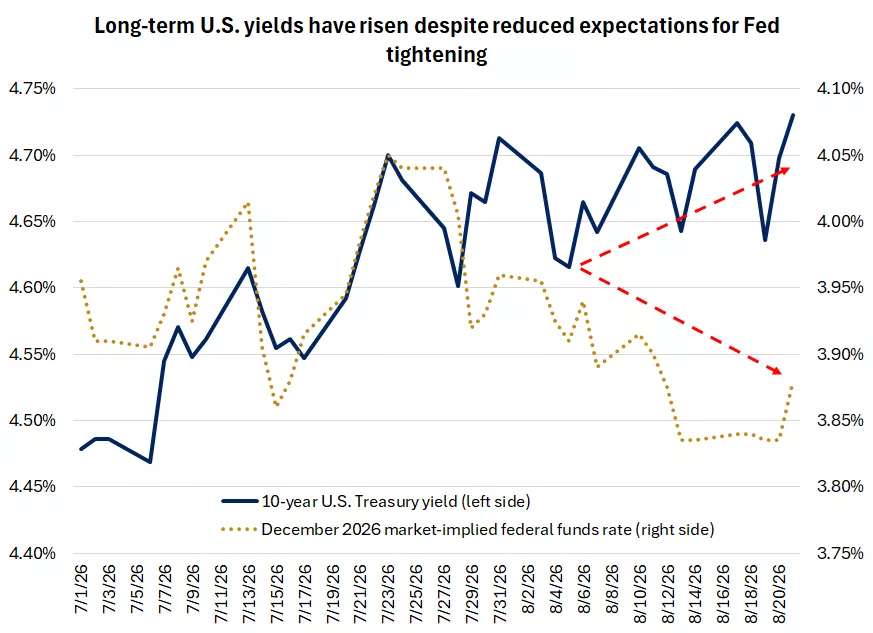
The chart shows that the 10-year U.S. Treasury yield has risen while expectations for Federal Reserve interest-rate hikes have eased.
The chart shows that the 10-year U.S. Treasury yield has risen while expectations for Federal Reserve interest-rate hikes have eased.
What's behind the move higher in long-term yields?
Although no single macroeconomic development fully explains the upward pressure on longer-term yields, we believe several factors have contributed to the move over the past several months:
- Higher bond supply: Elevated issuance of U.S. investment-grade corporate bonds may be contributing to the rise in yields. According to the Securities Industry and Financial Markets Association, or SIFMA, investment-grade U.S. corporate bond year-to-date issuance through July was 27.1% higher than during the same period in 2025.
- Ongoing geopolitical uncertainty: After falling below $70 per barrel in early July, West Texas Intermediate crude oil prices subsequently rebounded amid continued uncertainty in the Middle East and the flow of oil through the Strait of Hormuz. WTI rose back above $85 per barrel last week, adding to uncertainty about the outlook for global inflation. Encouragingly, however, market-based U.S. inflation expectations over the coming five- and 10-years remain contained. Additionally, last week’s inflation report showed that the Bank of Canada’s preferred core measures remained contained near its 2% target.
- Upward pressure on global yields: The rise in longer-term government bond yields has not been unique to North America. Long-term government bond yields in the United Kingdom, Japan, France and Germany have also moved toward multiyear highs. Although country-specific factors differ, the broadly synchronized increase may reflect a combination of heavier global government borrowing, renewed inflation uncertainty, and expectations that global policy rates could trend higher over the coming months.
- Investors demanding higher compensation to hold long-term U.S. bonds: Another factor contributing to higher long-term yields may be investors’ demand for greater compensation for the risks associated with holding longer-maturity U.S. bonds. The Federal Reserve Bank of New York publishes model-based estimates that decompose U.S. Treasury yields into two components:
- The expected average path of short-term interest rates over the life of the bond.
- The term premium, which represents the additional compensation investors require for the risk that interest rates may differ from expectations.
According to the New York Fed’s model, the estimated 10-year U.S. Treasury term premium has generally moved higher in recent years, suggesting investors are requiring higher compensation to hold long-term bonds. However, the term premium remains relatively contained by historical standards and does not appear to signal immediate cause for concern.
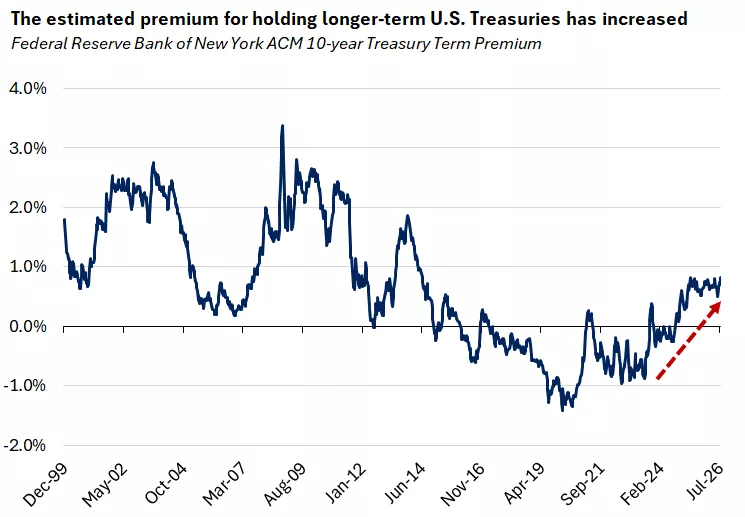
This chart shows that the Federal Reserve Bank of New York's 10-year U.S. Treasury Term Premium model suggests investors are demanding higher compensation for holding longer-term bonds in recent years. While the term premium has risen, it remains contained from a historical standpoint.
This chart shows that the Federal Reserve Bank of New York's 10-year U.S. Treasury Term Premium model suggests investors are demanding higher compensation for holding longer-term bonds in recent years. While the term premium has risen, it remains contained from a historical standpoint.
In our view, some increase in the U.S. term premium is understandable given the current environment. Large fiscal deficits and growing federal borrowing needs have increased the supply of Treasury debt, which may require higher yields to attract investors. At the same time, the Federal Reserve’s reduced reliance on forward guidance under Chair Kevin Warsh may have increased uncertainty about the path of monetary policy. We believe that uncertainty is especially relevant at a time when geopolitical developments are clouding the outlook for inflation. All else equal, greater policy uncertainty may lead investors to demand additional compensation for holding longer-term bonds.
Higher yields catch policymakers' attention
After the 30-year U.S. Treasury yield reached its highest level since 2007 last week, the Treasury Department announced that it will increase purchases of off-the-run (not recently issued) Treasury securities with 10 to 30 years remaining until maturity. Beginning September 9, the maximum purchase amount will rise from $2 billion to at least $4 billion per operation.
Although the increased purchases are small compared with the roughly $32 trillion Treasury market1, the announcement provided a powerful signaling effect, with the 30-year U.S. Treasury yield posting its largest daily decline in over a year. However, the program does not address the broader pressures that have contributed to higher yields, in our view, including large U.S. budget deficits, inflation uncertainty and increased debt supply. Reflecting this view, long-term yields recouped much of the initial decline. We expect these pressures to keep yields elevated, with the 10-year U.S. Treasury yield likely to trade between 4.5% and 5% over the remainder of the year. Looking forward, the U.S. administration is expected to unveil a fiscal consolidation initiative to help alleviate rising debt and funding costs, which may address some of the market uncertainty.
While soft patches exist, corporate and economic activity have been resilient overall
Interest-rate-sensitive parts of the economy have shown clear signs of weakness as borrowing costs have risen in recent years, with housing among the most affected sectors. Domestic inflation-adjusted residential investment has contracted in three of the past five quarters, while U.S. real residential investment has fallen in five of the past six quarters. Additionally, domestic home sales have moved lower in recent years amid a rise in borrowing costs.
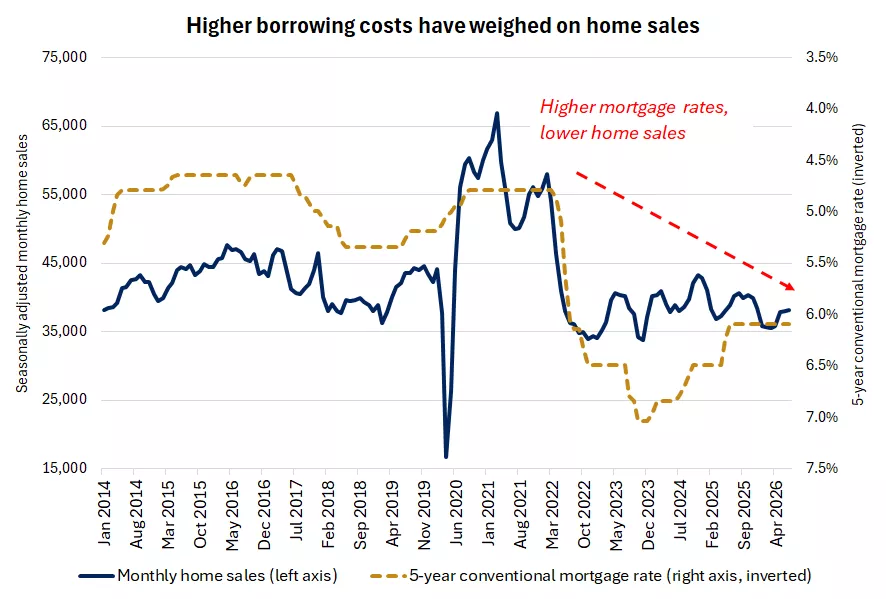
This chart shows that monthly home sales have declined amid higher mortgage rates in recent years. Past performance does not guarantee future results.
This chart shows that monthly home sales have declined amid higher mortgage rates in recent years. Past performance does not guarantee future results.
The silver lining, in our view, is that several areas of the economy have remained resilient despite higher interest rates. In Canada, employment growth has improved in recent months, while June retail sales pointed to healthy consumer spending at the end of the second quarter. In the U.S., the preliminary reading for the S&P Global Composite PMI rose to 56.04, its highest reading since March 2022 and signaling healthy business activity.
Corporate earnings have provided another source of support for markets, with results exceeding expectations this year. TSX earnings are on pace to grow 25% year-over-year in 2026, while S&P 500 earnings are tracking growth of more than 30%.
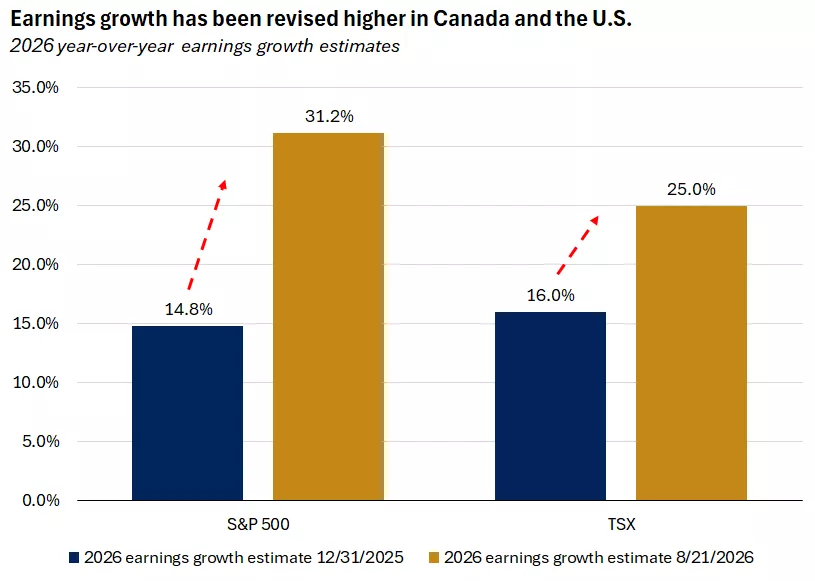
The chart shows that earnings growth estimates have been revised higher in 2026 for both the TSX and S&P 500. An index is unmanaged, cannot be invested into directly and is not meant to depict an actual investment.
The chart shows that earnings growth estimates have been revised higher in 2026 for both the TSX and S&P 500. An index is unmanaged, cannot be invested into directly and is not meant to depict an actual investment.
Positioning portfolios in a higher interest-rate environment
We expect U.S. fiscal concerns, increased bond issuance, broadly resilient economic activity, and inflation uncertainty to keep interest rates elevated for some time. However, we expect yields to remain largely within a range of 3.5% to 4.0% for the 10-year GoC yield and 4.5% to 5.0% for the 10-year U.S. Treasury yield through year-end. Despite Canada’s stronger fiscal backdrop, its close economic and financial ties with the U.S. could allow upward pressure on U.S. yields to spill over into Canada, as we saw last week. While this may limit meaningful near-term price appreciation, higher yields have improved the longer-term appeal of investment-grade bonds and reinforced their strategic role in a well-diversified portfolio, in our view.
Against this backdrop, we believe the outlook over the next 12 months favours equities over fixed-income, particularly given the support from strong profit growth and healthy economic activity. Within equity markets, we acknowledge the potential for a period of near-term consolidation after what's been a solid move higher in 2026. August and September have historically been seasonally weaker months for stocks, and uncertainty could increase as the U.S. midterm elections approach, but periods of weakness may provide opportunities to add to equtiies, in line with your investment goals and risk tolerance. We specifically favour U.S. large-cap stocks, which we believe offer an attractive combination of quality, exposure to artificial intelligence, and sensitivity to continued U.S. economic resilience. We also favour Canadian small- and mid-cap stocks, which we think could benefit from elevated commodity prices and improving domestic economic activity, along with emerging-market stocks, which we believe provide international exposure to strong profit growth tied to the AI buildout, while trading below their 10-year average forward price-to-earnings multiple.
Brock Weimer, CFA
Investment Strategy
Source for all data not cited: FactSet.
- Source: Treasury Department. Debt held by the public which does not include intragovernmental holdings of Treasuries.
Brock Weimer
Brock Weimer is an Associate Analyst on the Investment Strategy team. He is responsible for analyzing economic data, assessing market trends, and supporting the development of resources that help clients work toward their long-term financial goals.
Important information:
The Weekly Market Update is published every Friday, after market close.
This is for informational purposes only and should not be interpreted as specific investment advice. Investors should make investment decisions based on their unique investment objectives and financial situation. While the information is believed to be accurate, it is not guaranteed and is subject to change without notice.
Investors should understand the risks involved of owning investments, including interest rate risk, credit risk and market risk. The value of investments fluctuates and investors can lose some or all of their principal.
Past performance does not guarantee future results.
Market indexes are unmanaged and cannot be invested into directly and are not meant to depict an actual investment.
Diversification does not guarantee a profit or protect against loss.
Systematic investing does not guarantee a profit or protect against loss. Investors should consider their willingness to keep investing when share prices are declining.
Dividends may be increased, decreased or eliminated at any time without notice.
Special risks are inherent to international investing, including those related to currency fluctuations and foreign political and economic events.
Before investing in bonds, you should understand the risks involved, including credit risk and market risk. Bond investments are also subject to interest rate risk such that when interest rates rise, the prices of bonds can decrease, and the investor can lose principal value if the investment is sold prior to maturity.