Markets take a breather as earnings outlooks come to the forefront
Key Takeaways:
- Market leadership is rotating. After a strong rally earlier this year, we are seeing a pullback in U.S. AI-related areas, like semiconductors, while cyclical and defensive sectors are leading more recently. While sector rotations may be ongoing, investors continue to stay invested, which has supported broader markets.
- Earnings season will be a key test for the AI trade. The S&P 500 second quarter earnings season is underway, and expectations remain high. Growth in the technology sector is forecast to be about 63%, contributing over 50% of overall S&P 500 earnings growth. Investors will be monitoring AI capex growth forecasts, and what the return on this investment could look like.
- The Fed and Bank of Canada are likely to keep interest rates on hold this year but will be monitoring data closely. With inflation elevated but contained and the labor market stable, the most likely outcome is that the central banks keep interest rates unchanged this year. This could provide a relatively steady backdrop for earnings growth and equity markets.
Stock market rotations at the sector level, and within sectors
After a near 11% rally this year, the S&P 500 took a breather this week, down over 1%. The Canadian TSX was also down modestly for the week in local currency terms.
Underneath the surface, U.S. markets are seeing more rotation, both among sectors and within sectors. At the sector level, we have seen AI-driven sectors like technology underperform, while more cyclical and defensive areas have held up better. This has been the case not only over the last week, but since early June.
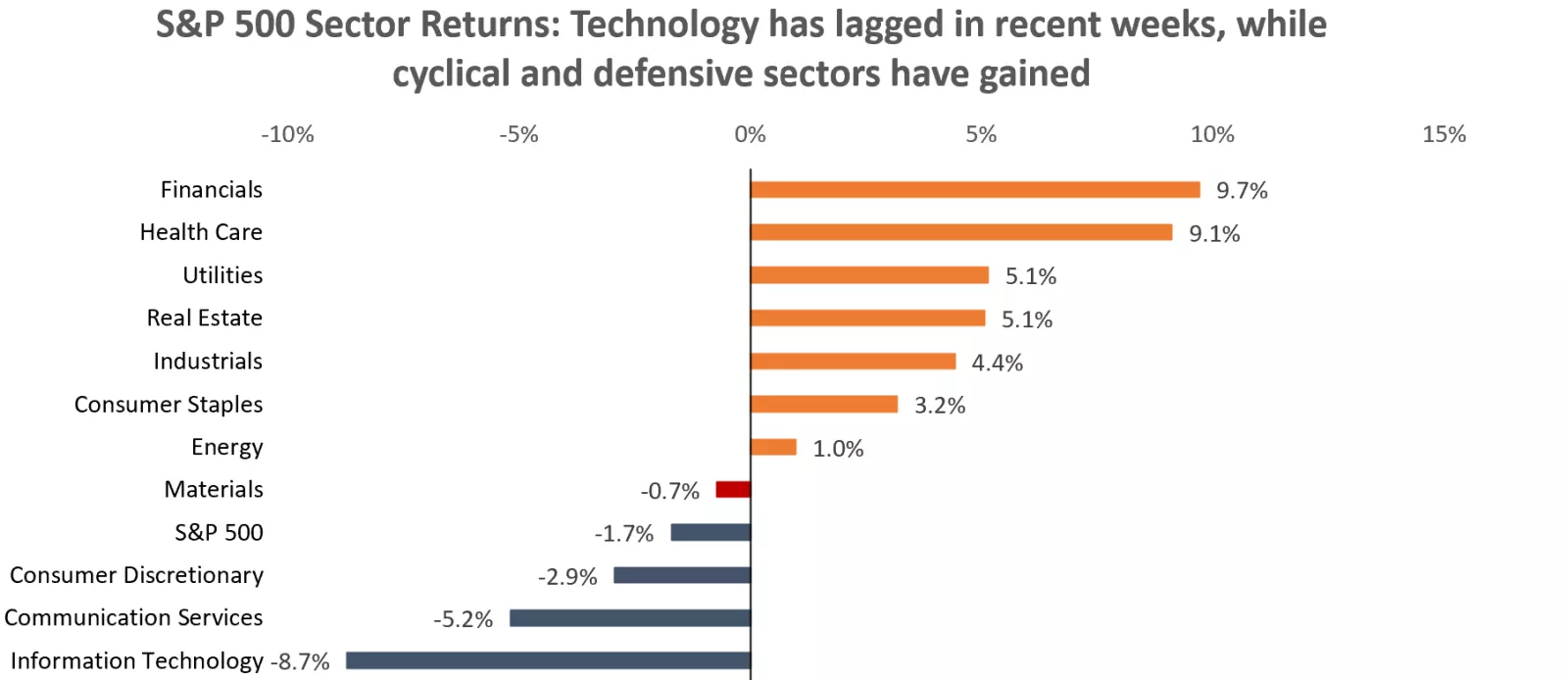
The chart shows that technology returns have lagged in recent weeks, while cyclical and defensive sectors have gained. Past performance does not guarantee future results.
The chart shows that technology returns have lagged in recent weeks, while cyclical and defensive sectors have gained. Past performance does not guarantee future results.
The parts of the market that had the sharpest rallies earlier this year, including semiconductor stocks, have seen the biggest pullbacks as well. This is not too surprising, given that parabolic moves in the market tend not to be sustainable – as there is some natural profit-taking and consolidation that brings these sub-sectors down again.
Keep in mind however that despite the recent pullback and rotation, many of these sectors are still up for the year. For example, the SOX Semiconductor index is down about 20% from its June highs but is still higher by around 64% for the year.
Within the U.S. technology sector, we are also seeing somewhat of a rotation. The semiconductor and hardware parts of tech are lagging, while the software and cloud sectors seem to be recovering. Names like Microsoft and SalesForce are rebounding, while AI infrastructure stocks are lagging.
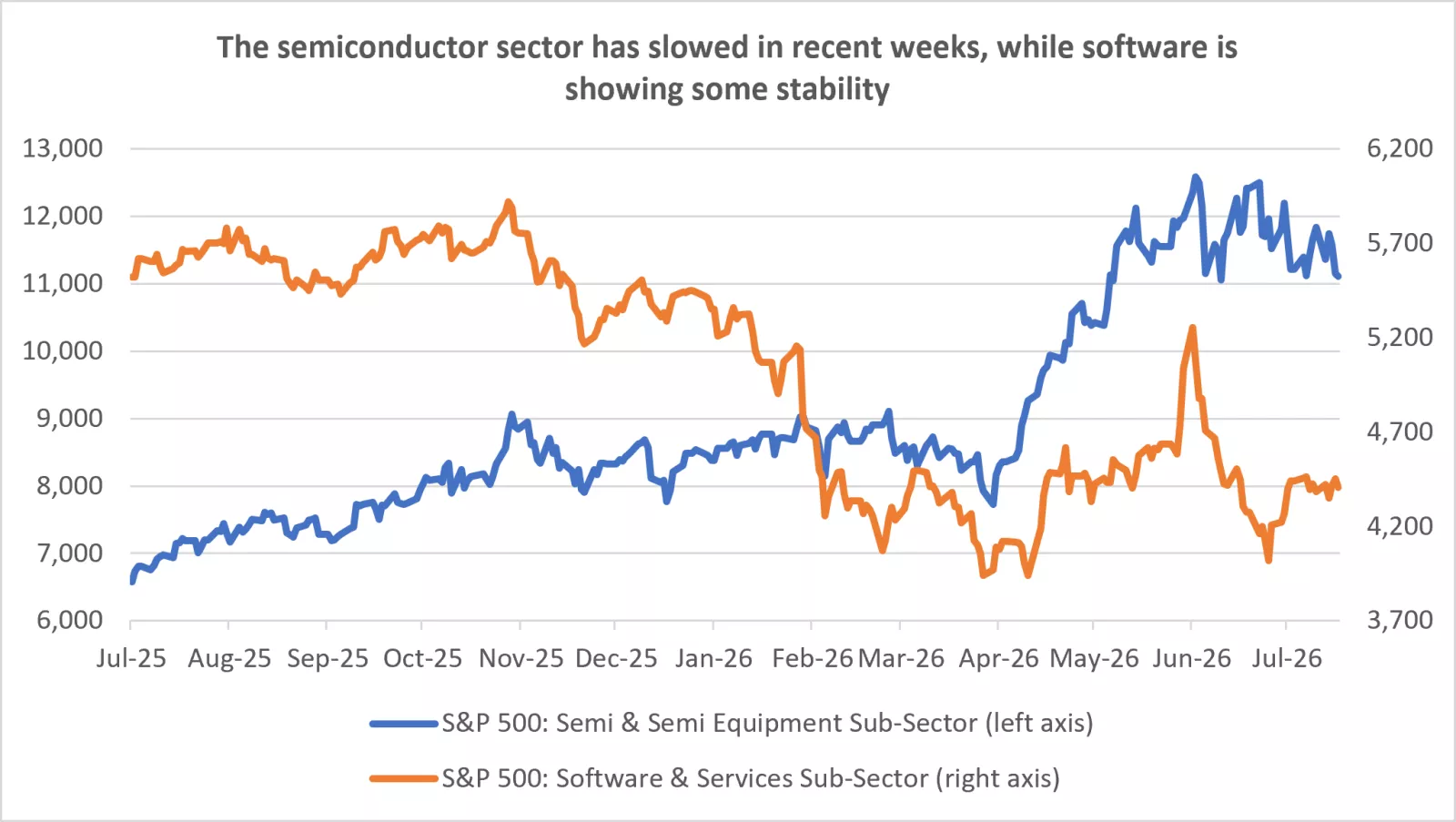
The chart shows that the semiconductor sector has slowed, while software is showing some stability. Past performance does not guarantee future results.
The chart shows that the semiconductor sector has slowed, while software is showing some stability. Past performance does not guarantee future results.
Bottom line: Parts of the U.S. technology sector, like semiconductors, had perhaps run too far, too fast, and are now giving back some of these gains. In our view, while the fundamentals of the story remain in-tact, with strong revenue, earnings, and backlogs, some of this good news may be reflected in the price already. Nonetheless, if earnings season delivers on lofty forecasts and the outlooks remain robust, we may see tech resume its leadership, especially in parts of the market that have lagged most.
All eyes on earnings season
Earnings growth has been a bright spot for corporations all year. As we enter Q2 earnings season, S&P 500 earnings growth forecasts have been revised substantially higher, from about 14% year-over-year to currently around 25%. Similarly, Canadian TSX earnings growth estimates have gone from about 15% to 30% for the second quarter.
The upward revisions have been driven mostly by the energy, and in the U.S. both energy and technology sectors have contributed to the higher earnings growth estimates.
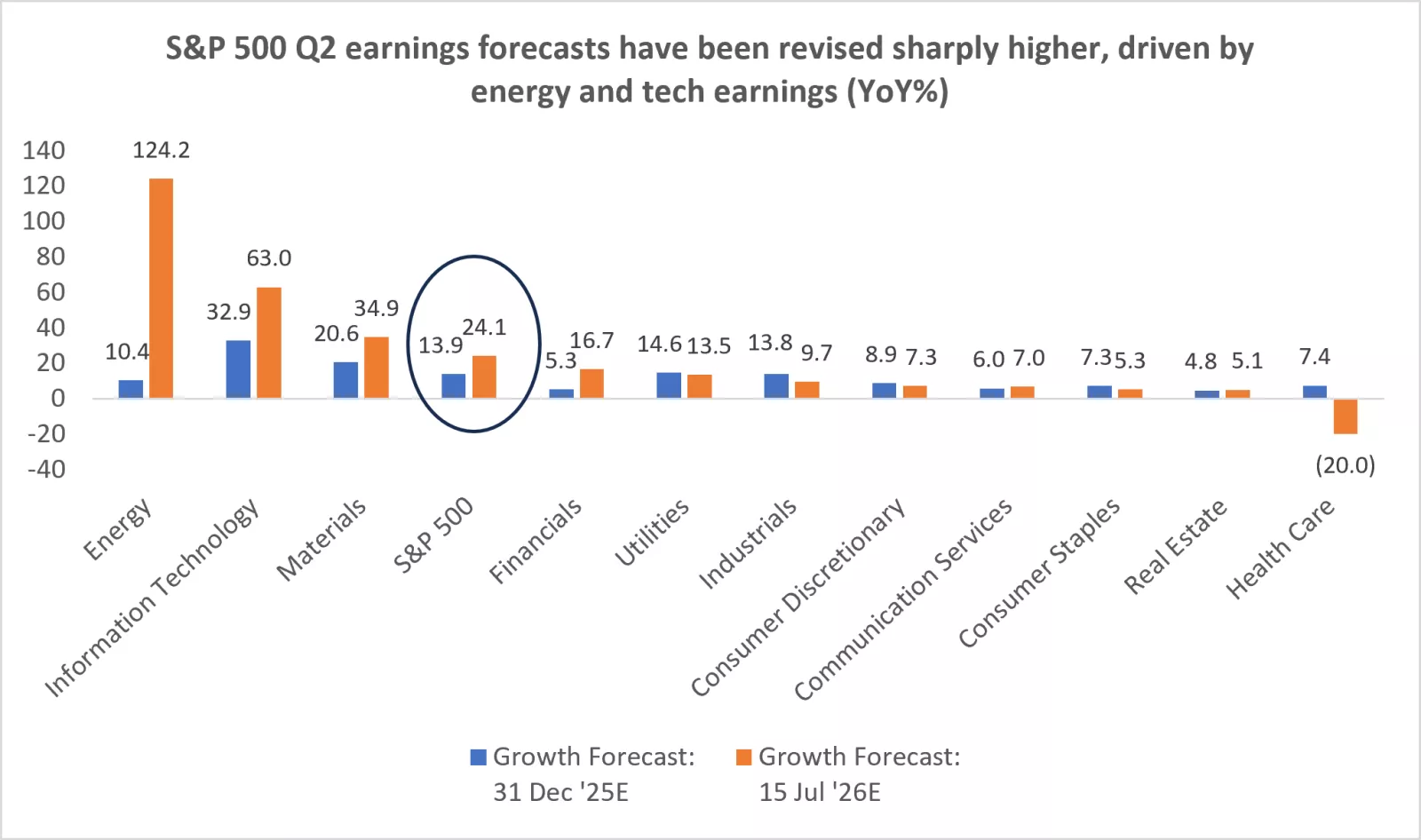
The chart shows that S&P 500 second quarter earnings forecasts have been revised higher, driven by energy and tech earnings.
The chart shows that S&P 500 second quarter earnings forecasts have been revised higher, driven by energy and tech earnings.
As companies continue to report earnings this quarter, investors will be watching for clues on whether earnings growth is sustainable, especially in the U.S. technology sector. In particular, there are three questions worth monitoring in the upcoming S&P 500 earnings season:
- What is the growth of AI capex spending going forward? This year, AI capex spending is expected to grow a stellar 75% to between $700 and $800 billion. However, in the next year or two, the pace of this growth will likely slow, with forecasts calling for 25% growth in 2027 and 6% in 2028. If we hear companies reaffirm this guidance, or even exceed it, tech stocks and the semiconductor sector in particular may respond positively.
- Are technology companies seeing sufficient revenue gains from the AI capex spend? Investors will also be watching to see if the companies that are spending on capex, hyper-scalers like Meta and Alphabet, report stronger revenues or point to returns on these investments. If they can justify the spending with better returns, investors will likely reward them accordingly.
- What is the state of the consumer? Finally, investors will be watching to see if the U.S. consumer remains healthy. Thus far, the large banks have reported, including J.P. Morgan, Citi, and Goldman Sachs, and all have pointed to resilient loan growth, credit quality and spending. Consumption is a key driver of economic growth, and more signs of a solid consumer will be welcome for investors.
Bottom line: Q2 earnings season is setting up to be a meaningful one in the U.S. and Canada. In the U.S. technology sector, investors are looking for trends on AI capex spending and return on this investment. More broadly, the bar for earnings growth is set relatively high, but if companies can deliver – and reaffirm a solid outlook – this may be supportive of the ongoing earnings-driven market rally we've seen this year.
The Fed and Bank of Canada (BoC) likely remain on hold
The final piece of the puzzle may lie with the central banks and what direction they take interest rates this year. At the latest meetings, the BoC kept rates on hold at 2.25%, while the Fed also kept rates on hold at 3.5%-3.75%.
The FOMC remained divided on the path of interest rates for the rest of the year. Half the members felt keeping rates on hold (or lowering them) was appropriate, while half felt rate hikes were appropriate.
In our view, rate cuts are likely off the table this year, but rate hikes are not a forgone conclusion. This past week, U.S. inflation figures were promising: Both CPI and PPI inflation surprised to the downside for headline and core inflation. In Canada, headline CPI remains at 3.2%, but core CPI (ex- food and energy) is at a much lower 1.6%.
Since the last readings, however, we have seen oil prices move back higher, and uncertainty around the Iran War remains an overhang.
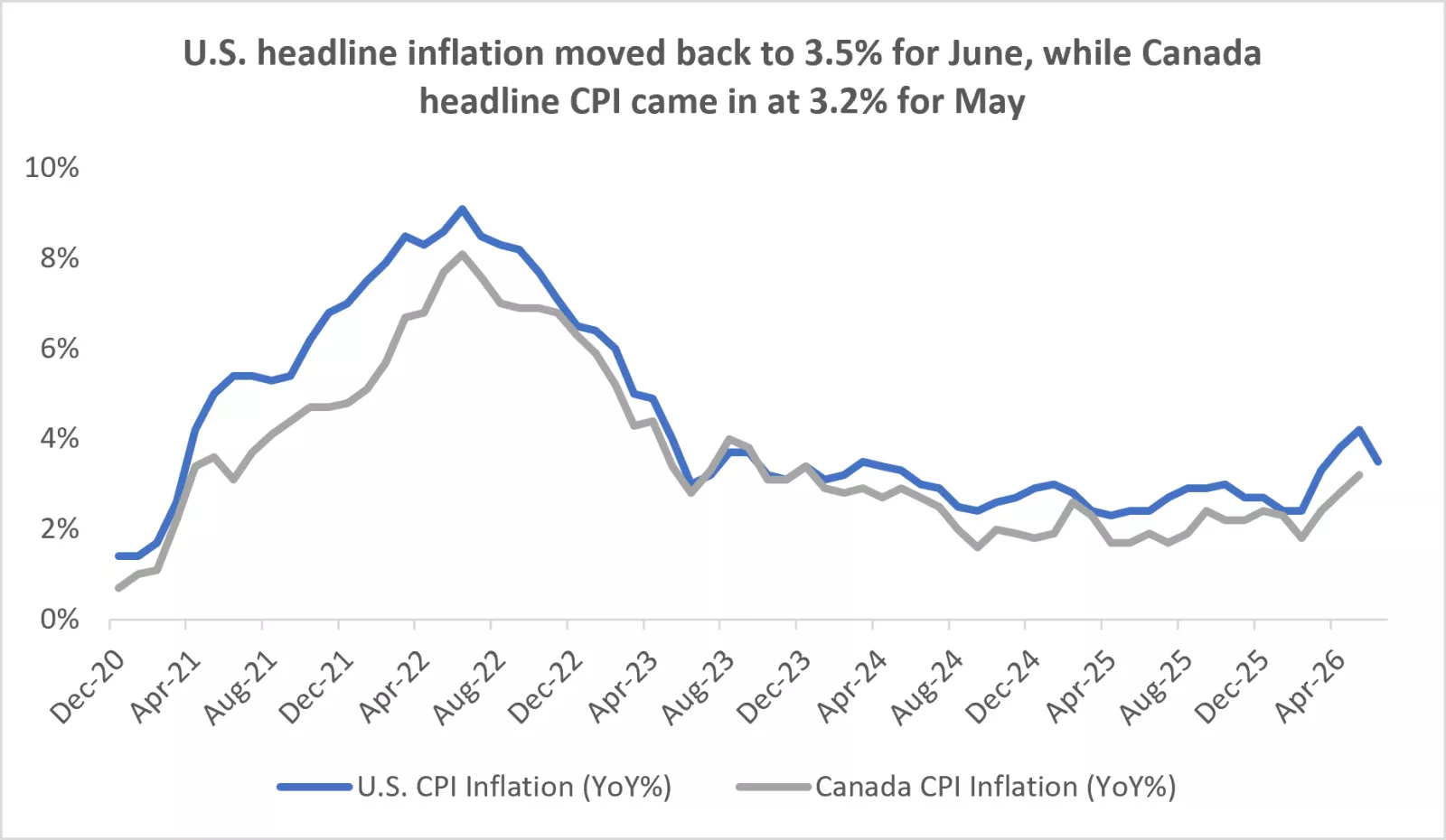
The chart shows that U.S. CPI inflation moved lower in June, while Canada CPI came in at 3.2% in May.
The chart shows that U.S. CPI inflation moved lower in June, while Canada CPI came in at 3.2% in May.
Bottom line: We believe that the Fed and BoC are likely to keep interest rates on hold for the rest of 2026. At the upcoming July 29 meeting, the Fed will likely outline what data it is monitoring to determine the path going forward.
Nonetheless, with inflation still contained and the labor market stable, the bar for rate hikes remains high in our view. The U.S. and Canadian economies have held up well with interest rates at these levels, and we would expect steady interest rates to continue to support this trend.
Remain diversified, remain invested
Overall, equity markets have had a solid year despite geopolitical uncertainty and rotation in the U.S. tech and AI sectors. The S&P 500 is now up about 9% for the year, and the Canadian TSX is up about 11%.
While we could continue to see rotation underneath the surface, the good news is that investor appetite for stocks remains robust. This is likely because earnings growth and economic growth continues to deliver. We will be monitoring key trends and takeaways in this quarter's earnings reports as well.
As we look toward the second half of 2026, we recommend investors review their portfolios to ensure they are adequately diversified, in line with their risk and return preferences, and across tech and non-tech parts of the market. We recommend overweight positions in U.S. large cap and Canadian small and mid-cap stocks, as well as emerging market equities. Your financial advisor can help ensure your investments are aligned to meet your personal long-term financial goals.
Mona Mahajan
Investment Strategist
Source for all data in commentary: Bloomberg, FactSet
Mona Mahajan
Mona Mahajan is responsible for developing and communicating the firm's macro-economic and financial market views. Her background includes equity and fixed income analysis, global investment strategy and portfolio management.
She regularly appears on CNBC, Bloomberg TV, The Wall Street Journal and Barron's.
Mona has an MBA from Harvard Business School and bachelor's degrees in finance and computer science from the Wharton School and the School of Engineering at the University of Pennsylvania.
Important information:
The Weekly Market Update is published every Friday, after market close.
This is for informational purposes only and should not be interpreted as specific investment advice. Investors should make investment decisions based on their unique investment objectives and financial situation. While the information is believed to be accurate, it is not guaranteed and is subject to change without notice.
Investors should understand the risks involved of owning investments, including interest rate risk, credit risk and market risk. The value of investments fluctuates and investors can lose some or all of their principal.
Past performance does not guarantee future results.
Market indexes are unmanaged and cannot be invested into directly and are not meant to depict an actual investment.
Diversification does not guarantee a profit or protect against loss.
Systematic investing does not guarantee a profit or protect against loss. Investors should consider their willingness to keep investing when share prices are declining.
Dividends may be increased, decreased or eliminated at any time without notice.
Special risks are inherent to international investing, including those related to currency fluctuations and foreign political and economic events.
Before investing in bonds, you should understand the risks involved, including credit risk and market risk. Bond investments are also subject to interest rate risk such that when interest rates rise, the prices of bonds can decrease, and the investor can lose principal value if the investment is sold prior to maturity.